A quick DFM review made this carbon fiber drone frame 10 minutes faster to machine
A commercial drone customer was already producing a CF frame at low volume. Their original design forced the CNC feed rate down to 12 inches per minute at the tight radii. We DFM'd the file, took 10 minutes of run time off every part, sampled the revised frame, and now ship it on a recurring basis. Along the way we also sampled their 3D-printed BOM parts — those samples came back cleaner, faster, and at lower cost than their current supplier. That side hasn't moved yet; the proof is on file for when it does.
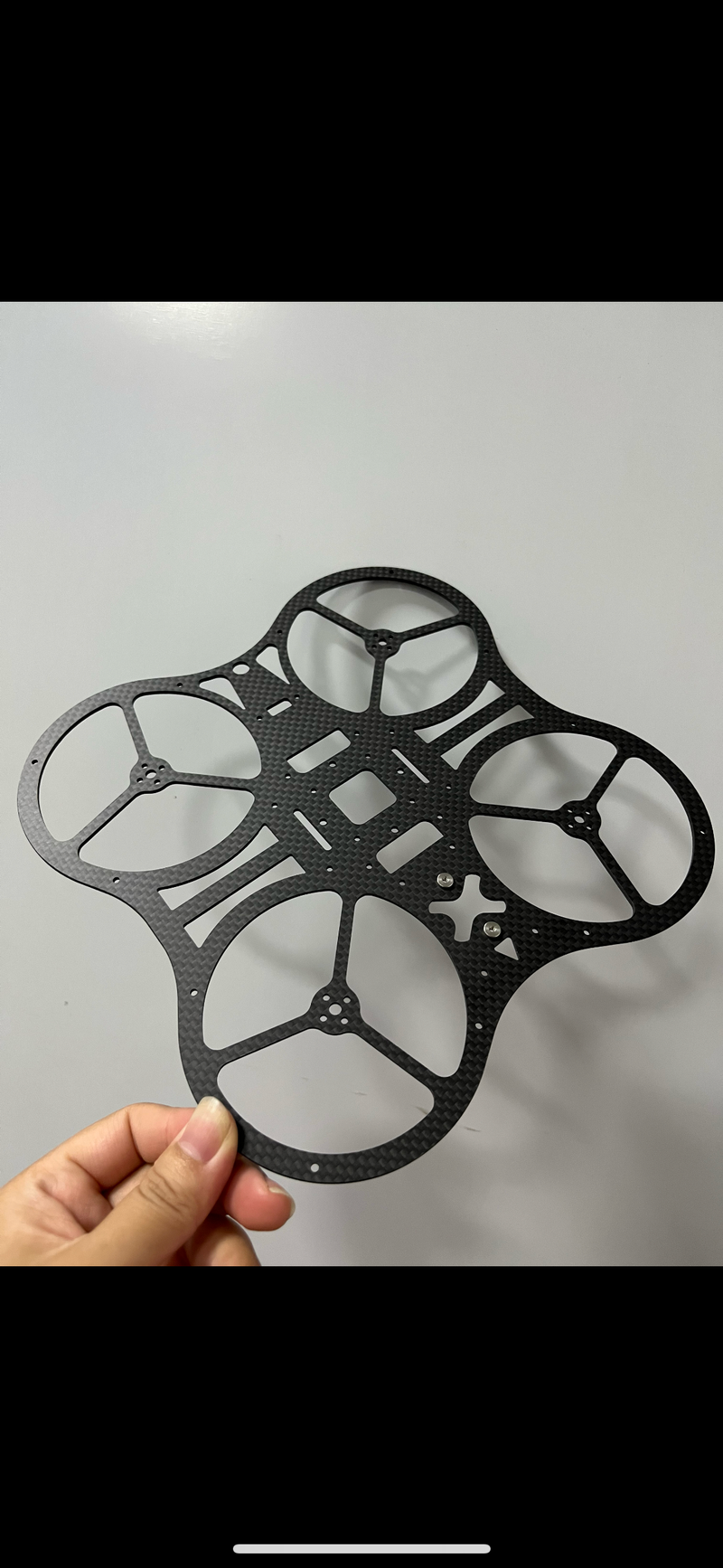
A frame already in production. Running slower than it had to.
The customer had been building this quadcopter frame in low volume for a while — a solid design that worked, with field-tested airframes already flying. The frame itself wasn't the problem. The toolpath was. Tight internal radii in a few features forced the previous shop to drop their CNC feed rate down to 12 inches per minute to avoid stressing the end mill and spalling the CF edge. The rest of the part cut fast; those few features dominated the run time and the per-part cost.
Rather than quote the file as-drawn, we opened it, found the room to fix it, and came back with a revised toolpath that cut 10 minutes off every part. That was before the first chip hit the floor.
DFM → samples → production. Same engineer across all three.
DFM review — the 12-ipm bottleneck
The frame design worked. The toolpath didn't. At the tight internal radii, the previous shop was running down to 12 inches per minute to avoid stressing the end mill and spalling the CF edge. On a batch of frames those few features alone added up to real time and real money. Our composites engineer opened the file and found room to relax the geometry without affecting fit, function, or how the mating 3D-printed BOM parts seated against it.
Samples — plus a proof point on the rest of the BOM
With the revised toolpath locked, we cut the first sample batch of CF frames and sent them to the customer. They slotted into the existing BOM of 3D-printed accessory parts on the first try — every mating feature fit as designed. The customer confirmed the frame itself was now better than what they had been shipping.
Then came a question we often get once a customer sees how we work: could we handle the 3D-printed BOM parts too? Same network, different capability — we route additive work to vetted shops the same way we route CF. We sampled the 3DP parts in parallel. They came back with better finish quality than what the customer was currently paying for, faster lead time, and lower unit cost. The CF frame moved to our production; the 3DP samples sit as a proof point for when the customer decides to move that side over.
- CF frame samples fit the existing 3DP BOM on the first article
- 3DP BOM parts also sampled through our additive network — approved on first batch
- 3DP samples: better finish quality than the customer's current supplier
- 3DP samples: faster lead time than the customer's current supplier
- 3DP samples: lower unit cost than the customer's current supplier
- The shops in our network: top-tier capability with idle capacity, hungry for work
Recurring production
The customer now ships CF frames with us on a recurring basis — same shop since the first batch, same engineer, same spec locked. Shop pre-tooled from the prior rounds, so each new release ships faster than any new-sourcing arrangement would. Volumes have grown as they scale their build schedule.
- Recurring CF frame orders with the same account
- Same shop across every round, pre-tooled and dialed in
- Faster delivery and lower unit cost than the prior arrangement
- 3DP BOM samples remain on file — ready to pick up if the customer decides to move that side over
CF being cut in the shop.
Two clips from the production run — material being removed from the plate stock on the router, and the finished frames before de-nesting. Shot by our shop partner during one of the recurring orders.
This machine uses an abrasive belt to sand the top surface of a part to a consistent finish or thickness. Vacuum hold-down keeps flat parts in position as they travel through.
Spindle running a polish over the cut edges with the vacuum shoe tracking the tool. Keeps the carbon dust off the bed and inside the extractor so the frames come off clean, ready for insert press-fit and inspection.
Finished frames, from the standing run.
Shots from the admin — some from the first sample batch, some from the recurring production. T300 twill 2×2 pattern reads clearly; motor mount cutouts, central FC pocket, antenna-mast holes called out on the drawing.
The numbers that mattered to the customer.
The specifics the customer tracks in their build program — turnaround, consistency, and whether the parts they get this week match the parts they got last week.
The previous shop was living with 12 inches per minute at the tight radii because that's what the file said. We opened it, relaxed what we could without affecting function, and 10 minutes came off every part. Then the customer asked if we could sample their 3D-printed BOM too. Same network, same answer — the samples came back cleaner, faster, and cheaper than their current supplier. That's how it usually goes with our customers: we win on one part first, and the account grows from there.
Carbon fiber drone frames — the questions we hear every week.
Direct answers for engineers scoping a drone frame or a broader carbon-fiber BOM. The same flow works for FPV airframes, UAV structural plates, gimbal housings, and cycling parts.
- How is a carbon fiber drone frame actually machined?
- For thin plate stock (1–3 mm T300/T700 twill or UD CF) the right process is CNC routing with diamond-coated or PCD tooling, aggressive dust extraction, and a vacuum fixture — not a general-purpose machining center. The frame on this case study is 2 mm T300 twill 2×2 routed on a dedicated composite shop, with climb-cut direction on the arm profiles and a wide-belt sander as the finishing pass to deburr the edges.
- What file formats do you accept for a carbon fiber drone part quote?
- STEP is ideal (parametric geometry survives the toolpath planning), DXF for 2D cut profiles, and PDF drawings for anything with tolerances, call-outs, or press-nut specs. STL works for reference. We also accept a BOM or an assembly file for whole-airframe sourcing. Upload at openspindle.com/quote — we return a real quote and a DFM note within a business day.
- What is the minimum order for custom carbon fiber drone frames?
- One. Prototype quantity is quoted seriously, not deprioritized behind a production run. The drone frame in this case study moved from first-article sample to a recurring release with the same shop pre-tooled — the standard sequence for the commercial drone programs we support.
- Can you source the whole BOM, including the 3D-printed accessory parts?
- Yes. On this project we sampled the customer's 3D-printed accessory parts in parallel through our additive network (SLS and MJF nylon in the usual CF-drone context). The samples came back cleaner, faster, and cheaper than their incumbent supplier. The samples remain on file so the customer can move that side over whenever they decide.
- Why does CNC feed rate matter so much for a carbon fiber drone frame?
- Feed rate is the dominant per-part time driver on a CF frame because small corner radii force a conservative feed to avoid stressing the end mill and spalling the composite edge. On this case study the previous shop was running down to 12 inches per minute at the tight features — a DFM pass relaxed the radii within tolerance for the mating 3D-printed parts, and the shop now runs full feed through the whole part. 10 minutes off every part.
- How quickly can you turn around a recurring carbon fiber drone frame release?
- Because the shop that cut the first sample batch is the shop that still runs the recurring order, it is pre-tooled and dialed in — releases ship faster than any new-sourcing arrangement would. For an existing customer with locked tooling and a standing release, lead times are days, not weeks. First-time quotes come back in about 48 hours.
- Do you handle other carbon fiber parts besides drone frames?
- Yes. Carbon fiber at OpenSpindle covers CNC routing, waterjet, and 5-axis machining of plate, tube, and layups across drone frames, FPV airframes, UAV structural parts, cycling and bike parts, battle-drone / combat-robotics armour, cinematography and gimbal housings, and general lightweighting. The same DFM-to-production flow runs on any of them.
Already producing? There's probably time to save.
Upload the file. We'll come back in a business day with a real quote, a DFM review that finds the bottlenecks your current shop lives with, and a lead time we commit to. This is how most of our accounts grow — we win on one part first by making it better, faster, and cheaper than your current shop. Prove it there, and the rest of the BOM follows one part at a time.