Materials
Delrin vs Nylon: Which to Machine
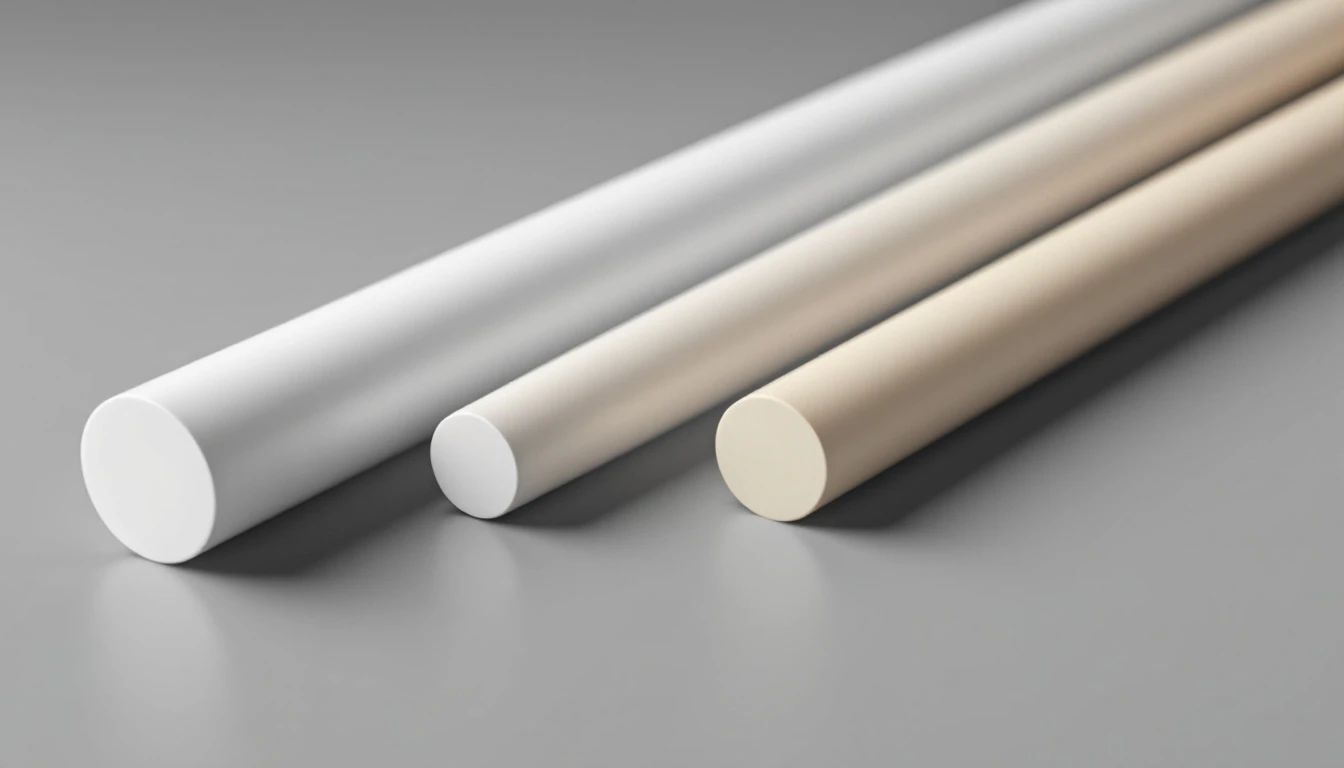
The short answer
Delrin is a DuPont trade name for acetal homopolymer, a polyoxymethylene. Nylon is a family of polyamides, usually nylon 6 or nylon 6/6. Acetal is stiffer, machines to tighter tolerances, has lower friction and barely absorbs water. Nylon is tougher, takes impact and abrasion better, and handles higher temperatures, but absorbs moisture and changes dimension as it does. If the part has a tight tolerance, choose acetal. If it takes shock or abrasion, choose nylon.
Trade names, and what sits behind them
Delrin is a trade name, not a material class. It is DuPont acetal homopolymer, a polyoxymethylene usually written POM-H. There is also acetal copolymer, POM-C, sold under names such as Celcon and Ultraform. The two are close relatives with one practical difference covered below.
Nylon is a whole family of polyamides. Machining stock is usually nylon 6 or nylon 6/6, and cast nylon 6 grades sold as MC901 or Nylatron are common in larger sections. Nylon 6/6 is stiffer and harder; cast nylon 6 comes in large sections without the internal stress of extruded stock.
Because both names cover several materials, a drawing that says only Delrin or only nylon is under specified. Say the polymer, the grade and any filler, because a glass filled nylon and an unfilled nylon are not interchangeable in any respect that matters.
Water is the whole argument
Nylon absorbs moisture from the air and grows as it does. Acetal essentially does not. Everything downstream of that follows.
A nylon 6/6 part machined dry from stock and then left in a humid room will keep changing size for weeks. The change is not trivial at typical indoor humidity, and at saturation it is enough to close a clearance fit or bind a shaft. It also softens the material and lowers its stiffness as it goes.
Acetal picks up a fraction of that and moves correspondingly less, which is why it is the default for precision plastic parts and why plastic gears and bearings that have to hold a tolerance are usually acetal rather than nylon.
None of this makes nylon unusable in precision work. It makes nylon a material you have to condition and design around: machine it, let it equilibrate, and hold looser tolerances on the dimensions that matter, or accept that the part will be right in the shop and different in service.
| Property | Acetal, POM-H and POM-C | Nylon 6/6 | Cast nylon 6 |
|---|---|---|---|
| Water absorption, 24 hours | About 0.2 to 0.25 percent | About 1.0 to 1.3 percent | About 0.6 to 0.9 percent |
| Water absorption at saturation | About 0.8 percent | About 7 to 8 percent | About 6 to 7 percent |
| Dimensional change with moisture | Very small | Significant, plan for it | Significant |
| Tensile strength | About 60 to 70 MPa | About 75 to 85 MPa dry | About 70 to 80 MPa dry |
| Flexural modulus | About 2.6 to 3.1 GPa | About 2.8 to 3.3 GPa dry, lower when conditioned | About 2.5 to 3.0 GPa dry |
| Coefficient of friction, dry against steel | Low, about 0.2 | Moderate, about 0.3 | Moderate |
| Impact toughness | Moderate | High | High |
| Continuous service temperature | About 90 C | About 100 to 120 C | About 100 C |
Published values vary meaningfully by grade, filler and supplier, and nylon properties are usually quoted dry as molded. Design to the datasheet for the grade you buy.
Machinability and the tolerance you can hold
Acetal is the easiest engineering plastic to machine well. It cuts cleanly, produces manageable chips, does not melt and smear at sensible speeds, and holds an edge on a fine feature. On a well set up job it will hold tolerances close to what a metal part would, and it stays there.
Nylon is harder to machine to a number, for two reasons that compound. It is tougher and more elastic, so it deflects away from the cutter and springs back, which makes a light finishing pass behave differently than it would in acetal. And it moves afterward with moisture. A shop can hit a tight number on a nylon part; it just cannot promise the part will still be at that number next month.
The practical guidance is to reserve tight tolerances for acetal, and where nylon is required for its toughness, put the tolerance on the features that are not fit critical and open up the ones that are. Specify conditioning if the part has to be dimensionally right in a humid environment, and say so on the drawing rather than assuming.
Wear, friction and which one lasts longer
Both are used for bearings, bushings, gears and wear pads, and they win in different conditions.
Acetal has lower friction against steel, better creep resistance, and better dimensional stability under sustained load. That combination makes it the better choice for a precision gear or a bushing running dry against a smooth shaft where the fit has to stay a fit.
Nylon takes abrasion and shock better. Against a rough or contaminated counterface, and in anything that gets hit rather than loaded steadily, nylon survives longer. Oil filled and molybdenum filled nylon grades extend that further, which is why sheave wheels, wear strips and heavy sliding pads are usually nylon.
Running speed and load are worth checking against the supplier PV limits rather than assumed. Both materials fail by softening when they overheat, and a bearing that is fine at low speed can run away thermally at high speed with no warning.
The two failure modes nobody mentions until it happens
Centerline porosity in acetal homopolymer. Larger diameter extruded POM-H rod can carry voids down its center from the way it cools. On a part machined from the middle of a large rod, that porosity can open into a sealing surface or a bore. Copolymer POM-C does not have the same tendency, which is the practical reason many shops prefer it in larger sections. If your part is machined from rod above roughly 50 mm and has a sealing face, ask which acetal is being used.
Bonding. Acetal is close to impossible to glue reliably without surface treatment, because the same chemical inertness that makes it a good bearing material makes it a poor adhesive substrate. Nylon is better but still difficult. Design mechanical joints, threads or inserts rather than planning to bond either of them.
Also worth knowing: acetal is attacked by strong acids and by chlorine, so it is a poor choice in pool chemistry despite being common in wet applications. Nylon is attacked by strong acids too, and is notably poor with formic and other organic acids, but handles alkalis and hydrocarbons well.
A selector by application
Read this by the constraint that would fail first. Most real choices are decided by one property, not a total score.
| Application | Material | Why |
|---|---|---|
| Precision gear or cam, dry running | Acetal | Dimensional stability and low friction |
| Bushing on a smooth shaft, steady load | Acetal | Low friction, good creep resistance |
| Bushing on a rough or dirty shaft | Nylon | Better abrasion resistance |
| Part that gets struck or dropped | Nylon | Higher impact toughness |
| Tight tolerance fit in a humid environment | Acetal | Nylon will move as it absorbs moisture |
| Large wear pad or sheave | Cast nylon 6 | Available in large sections, tough, oil filled grades exist |
| Manifold or fluid part with sealing faces | Acetal copolymer | Avoids centerline porosity risk in large sections |
| Part in contact with chlorine or strong acid | Neither, look further | Acetal is attacked by chlorine, both by strong acids |
| Service above about 100 C | Nylon, or a higher temperature polymer | Acetal is limited to around 90 C continuous |
| Part that must be bonded to something | Neither bonds well | Design a mechanical joint or an insert |
What to put on the drawing
Name the polymer rather than the brand where you can. Acetal homopolymer or acetal copolymer, nylon 6/6 or cast nylon 6, and any filler. Delrin on a drawing gets interpreted as any acetal by most shops, which is usually fine and occasionally is not.
If a dimension is fit critical on a nylon part, say what condition it applies in. Dry as machined and conditioned to equilibrium are different numbers, and the drawing is the only place to settle which one the part will be inspected at.
Say if the part will be exposed to a chemical, a temperature or a wash cycle. Both materials have specific chemical vulnerabilities that are easy to design past once known and expensive to discover in the field.
Then ask the shop one question: what stock size and form is this being cut from? Both materials come as extruded rod, plate and cast sections, and the answer affects the internal stress in the part, the porosity risk and the price.