The short answer
Specify molybdenum when the service temperature is above roughly 1000 °C in vacuum or inert atmosphere, when CTE match to silicon is driving the design (semiconductor equipment), or when thermal conductivity has to hold up at red heat. Otherwise, a nickel superalloy or copper tungsten is almost always the cheaper, faster, more machinable answer. Only a handful of US shops handle moly, and lead times run 3 to 6 weeks because mill sourcing is the gate.
When moly is actually the right material
Molybdenum earns its premium in a short list of situations. Vacuum furnace hot zones above about 1000 °C, where Inconel softens and stainless melts, routinely use pure Mo or TZM for crucibles, susceptors, and structural hardware. Semiconductor sputter targets and electrostatic chuck fixturing lean on moly because its coefficient of thermal expansion (about 4.8 µm/m·K) is close to silicon, so thermal cycles do not crack the bond between target and backing plate. Glass-melt electrodes and stirrers work in moly because it survives molten glass contact. X-ray tube anodes use moly for its combination of high melting point and reasonable thermal conductivity. Outside those cases, almost any high-temperature design that calls for moly should get a serious look from Inconel 625 or 718 first.
Pure Mo vs TZM: which grade
Pure 99.95% molybdenum is the baseline, with the best electrical and thermal conductivity in the family and the lowest cost. It is the right choice for unloaded hot-zone parts, electrodes, and sputter backing plates where strength is not driving the design. TZM (Mo-0.5Ti-0.08Zr-0.03C) adds enough alloying to roughly double the yield strength and raise the recrystallization temperature. It is the choice for stressed hot-zone parts like fasteners, support structure, and furnace tooling that will see load at temperature. Both are sourced through the same mills (Plansee, H.C. Starck, Edgetech, Elmet), so lead times are similar. The specialty variant MHC exists for the hottest applications but is rare enough that most design engineers never see it.
Why most shops decline moly RFQs
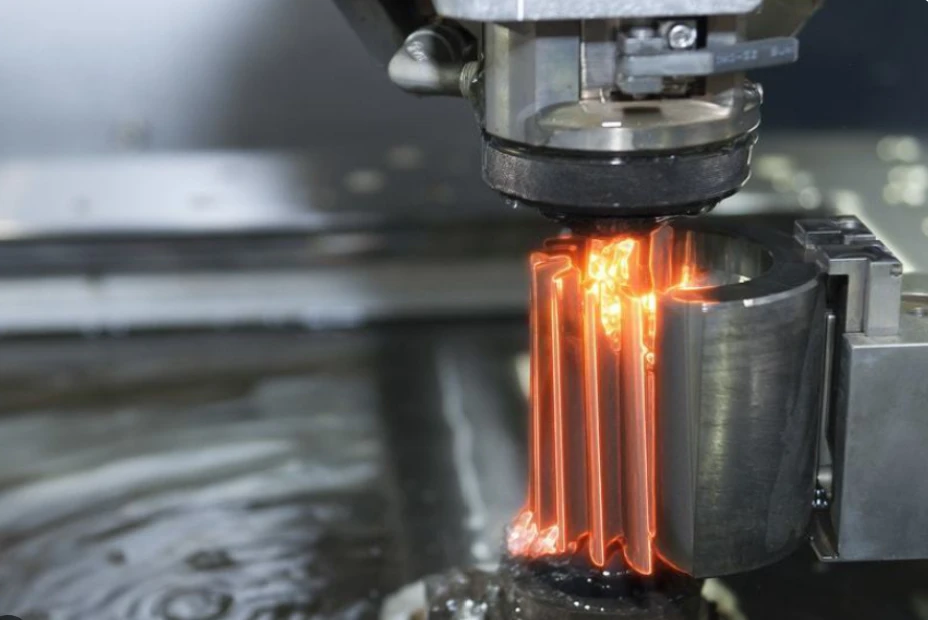
Three gates filter the shop list down. First, mill sourcing: Mo and TZM are specialty orders with long lead times and lot minimums; shops without existing accounts cannot source stock on a reasonable schedule. Second, machining: moly is brittle below room temperature, work-hardens aggressively, and gummy at some conditions. A general CNC shop without the carbide tooling library, rigid setups, and SFM confidence will scrap parts. Third, safety: moly dust from grinding and MoO3 fume from EDM are documented health hazards. The ventilation, dust capture, respiratory PPE, and SDS protocol for refractory metals is not optional. Shops that have not set up for it will not quote the job.
What to put on the drawing
Four callouts save weeks on a moly RFQ. State the grade exactly (Mo 99.95% or TZM; the alloy chemistry is spelled out in ASTM B386 for plate and B387 for rod). State the service atmosphere (vacuum, Ar, H2) and temperature, because that is what justifies the material choice to the quoting shop. State the required traceability (mill cert, lot number tied to the part serial) if the end use requires it. State realistic tolerances; moly is brittle, so sharp inside corners and thin walls will chip. Generous radii, EDM where features would be awkward to mill, and surface finish as-cut or ground rather than polished are all reasonable defaults.
What to expect on cost and lead time
A simple pocketed moly plate is typically 3 to 5x the cost of the same part in 6061 aluminum, driven more by material cost than machining time. A complex EDM part in TZM can be 5 to 10x. Lead times run 3 to 6 weeks for standard stock sizes and 8 to 12 weeks when the mill has to run a custom order. Quantities of one to ten are the norm for prototypes; low-volume production of 25 to 200 pieces is common for semi consumables and glass-melt hardware. If your project needs faster turnaround, the first conversation to have is which stock size your shop already has on the shelf, since that drives the material lead time more than anything else.
How to source moly through OpenSpindle
OpenSpindle routes refractory-metal RFQs only to shops that have told us they are set up to run them. See the molybdenum material page for grades, properties, and application notes, or send a drawing and we match it to shops with the mill accounts and PPE protocols to deliver. We also recruit shops specifically for this work; refractory capacity is scarce, so if you have a shop that handles moly or TZM routinely, point them at our refractory-metals shop recruitment page.
Last reviewed by Tom Petrini