Materials
Titanium vs Aluminum: When the Premium Is Worth It
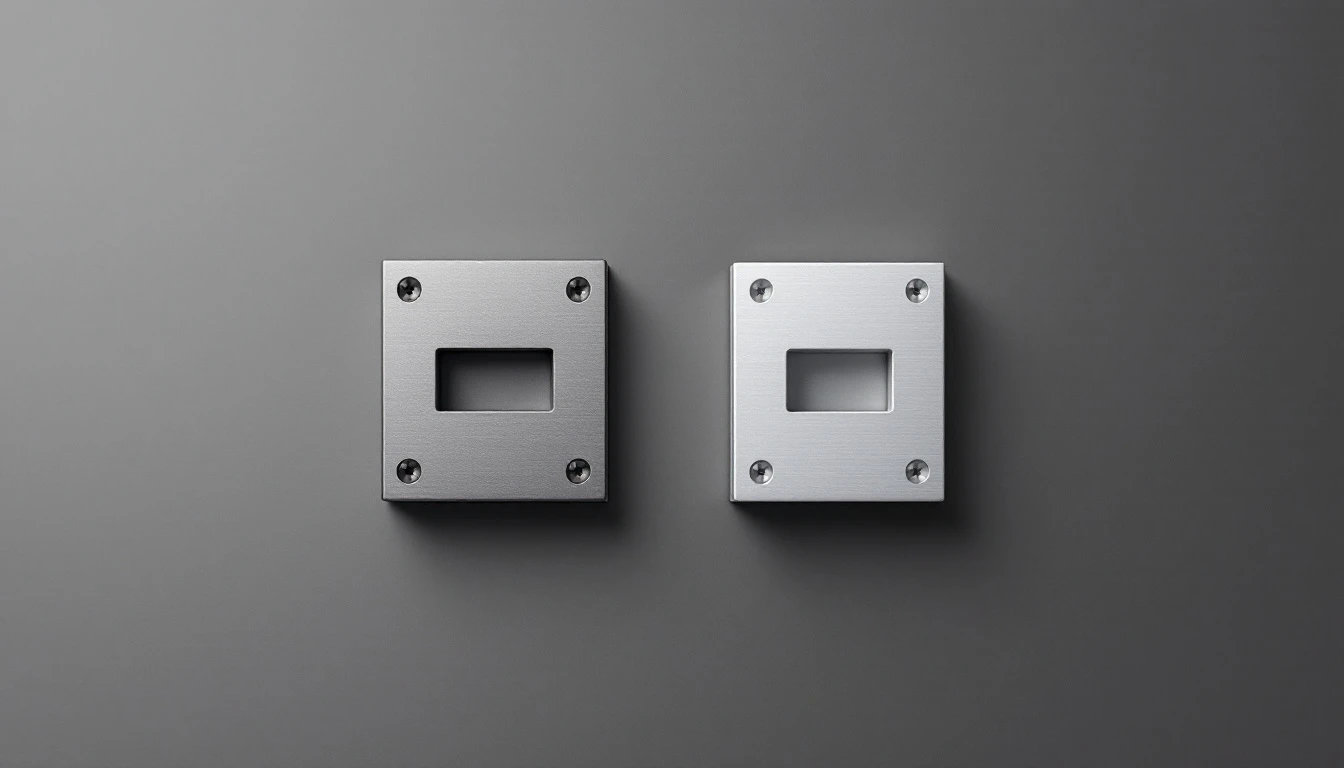
The short answer
Titanium is about 64 percent denser than aluminum but roughly three times stronger, so it wins decisively on strength-to-weight. It also machines four to eight times slower, which is why a titanium part often costs five to fifteen times its aluminum equivalent. Specify titanium when strength-to-weight, temperature resistance or biocompatibility genuinely drive the design, not when aluminum would do.
The numbers
| Property | Ti-6Al-4V (Grade 5) | 6061-T6 aluminum | 7075-T6 aluminum |
|---|---|---|---|
| Density | 4.43 g/cm³ | 2.70 g/cm³ | 2.81 g/cm³ |
| Yield strength | 880 MPa | 276 MPa | 503 MPa |
| Tensile strength | 950 MPa | 310 MPa | 572 MPa |
| Specific strength (yield/density) | 199 | 102 | 179 |
| Max service temperature | About 400 °C | About 150 °C | About 150 °C |
| Thermal conductivity | 6.7 W/m·K | 167 W/m·K | 130 W/m·K |
| Relative machinability | Very poor | Excellent | Excellent |
Specific strength is the number that matters for weight-driven design. Note that 7075-T6 lands much closer to titanium than 6061 does, which is why so many "we need titanium" parts turn out to be 7075 parts.
Why titanium costs what it does
Two things drive the price, and only one of them is the raw material.
The metal itself runs several times the cost of aluminum per pound. But the larger multiplier is machining time. Titanium has terrible thermal conductivity, about 6.7 W/m·K against aluminum at 167. That means the heat generated at the cutting edge stays at the cutting edge instead of flowing away into the chip and the part. Tools run hot, wear fast and get replaced often.
Titanium also work-hardens aggressively. A dwelling tool glazes the surface and the next pass has to cut through harder material than the drawing called for. Shops respond with low surface speeds, heavy flood coolant, rigid fixturing and sharp tooling replaced on a schedule. All of that is time on the machine, and time on the machine is the quote.
When titanium genuinely earns it
Titanium is the right answer when at least one of these is genuinely driving the design: strength-to-weight at the limit, where 7075 has already been evaluated and is not enough; service temperature above roughly 150 °C, where aluminum loses its temper; seawater or chemical corrosion resistance, where titanium is essentially inert; biocompatibility for implants and surgical instruments; or galvanic compatibility with carbon fiber, where aluminum corrodes and titanium does not.
That last one catches people. Bolting aluminum to a carbon fiber structure sets up a galvanic couple that eats the aluminum. Titanium is the standard fix.
When aluminum is the honest answer
If the part is a bracket, a housing, a heat sink, a fixture, or anything where the load case is comfortable, aluminum is almost certainly correct. It machines fast, anodizes in any color, conducts heat beautifully and costs a fraction as much.
The most common expensive mistake we see is specifying titanium for prestige or margin rather than for a requirement. If nobody can name the specific property driving the choice, it is a 6061 or 7075 part.
What titanium does to a quote
The material premium is the part everyone anticipates. The machining premium is the part that surprises people, and it is usually larger.
Because titanium conducts heat so poorly, the heat generated at the cutting edge stays there. Tools run hot and wear fast. Shops compensate with low surface speeds, heavy flood coolant, very rigid fixturing and a tool-change schedule. All of that is machine time, and machine time is most of what you are paying for.
| Cost component | Aluminum baseline | Titanium |
|---|---|---|
| Raw material | 1x | Several times higher |
| Cycle time | 1x | Typically 4 to 8x |
| Tooling consumed per part | Low | Substantially higher |
| Typical finished machined part | 1x | Roughly 5 to 15x |
| Lead time | Standard | Longer, and stock is less widely held |
Multipliers are directional and depend heavily on geometry. Deep pockets and thin walls widen the gap; simple prismatic parts narrow it.
Before you specify titanium, ask these three questions
Has 7075-T6 been evaluated and genuinely rejected? Its specific strength is much closer to Ti-6Al-4V than 6061 is, and it costs a fraction as much to machine. A large share of the titanium requests we see are 7075 parts that nobody re-checked.
What is the actual service temperature? If it is under about 150 °C, temperature is not your reason.
Is there a galvanic or biocompatibility constraint? Bolting aluminum to carbon fiber sets up a couple that corrodes the aluminum, and titanium is the standard fix. Implants and surgical instruments have their own requirement. Both are legitimate reasons that no amount of aluminum will satisfy.
If none of the three gives a clear answer, the honest recommendation is an aluminum part, and the money saved is better spent elsewhere in the build.
Designing a titanium part that can be made
The same geometry that machines comfortably in aluminum can be genuinely difficult in titanium, and the difference shows up as either a much higher price or a shop declining to quote. Four features drive most of it.
Thin walls. Aluminum tolerates walls down to roughly 0.8 mm on a well-fixtured part. Titanium deflects and chatters much sooner because the cutting forces are higher, so thin walls either need extra support, more passes at lighter cuts, or a redesign.
Deep pockets. Long, thin tools are already the enemy in aluminum. In titanium the combination of high cutting force and poor heat evacuation makes deep pockets disproportionately slow. Keeping depth under about three times the pocket width helps considerably.
Small internal radii. A small corner radius forces a small cutter, and a small cutter in titanium runs slowly and breaks readily. Opening a corner radius from 2 mm to 5 mm has a much bigger effect on a titanium part than the same change in aluminum.
Sharp external features and knife edges. These burr badly and are difficult to deburr without damaging the surrounding surface.
The practical point: if you are moving an existing aluminum design to titanium, it is worth a manufacturability review rather than a straight material substitution. The geometry that was free in aluminum may not be.
Grades worth knowing
Most machined titanium is one grade, but the alternatives matter in specific cases.
| Grade | Common name | Where it fits |
|---|---|---|
| Grade 5 | Ti-6Al-4V | The default. Roughly 95% of machined titanium. Strong, well understood, widely stocked |
| Grade 23 | Ti-6Al-4V ELI | Extra low interstitial. Medical implants, where fracture toughness matters |
| Grade 2 | Commercially pure | Much weaker but very formable and highly corrosion resistant. Chemical and marine |
| Grade 9 | Ti-3Al-2.5V | Tubing and hydraulics. Easier to form than Grade 5 |
| Grade 5 ELI annealed | Ti-6Al-4V annealed | Where machinability and stability matter more than peak strength |
If a drawing just says "titanium", expect Grade 5 and expect to be asked. Specify it.