The short answer
Wire EDM cuts hardened tool steel without cutting force, so D2, A2, S7, and H13 at 58-62 HRC machine exactly the same way they do soft. Expect profile tolerances to ±0.0002 in, surface finish 32 Ra as-cut dropping to 8-16 Ra with skim passes, and internal corner radii equal to half the wire diameter (0.004 in minimum with 0.008 wire). The cost drivers are wire length (part thickness times perimeter), skim passes, and material thickness, not shape complexity.
What wire EDM is doing
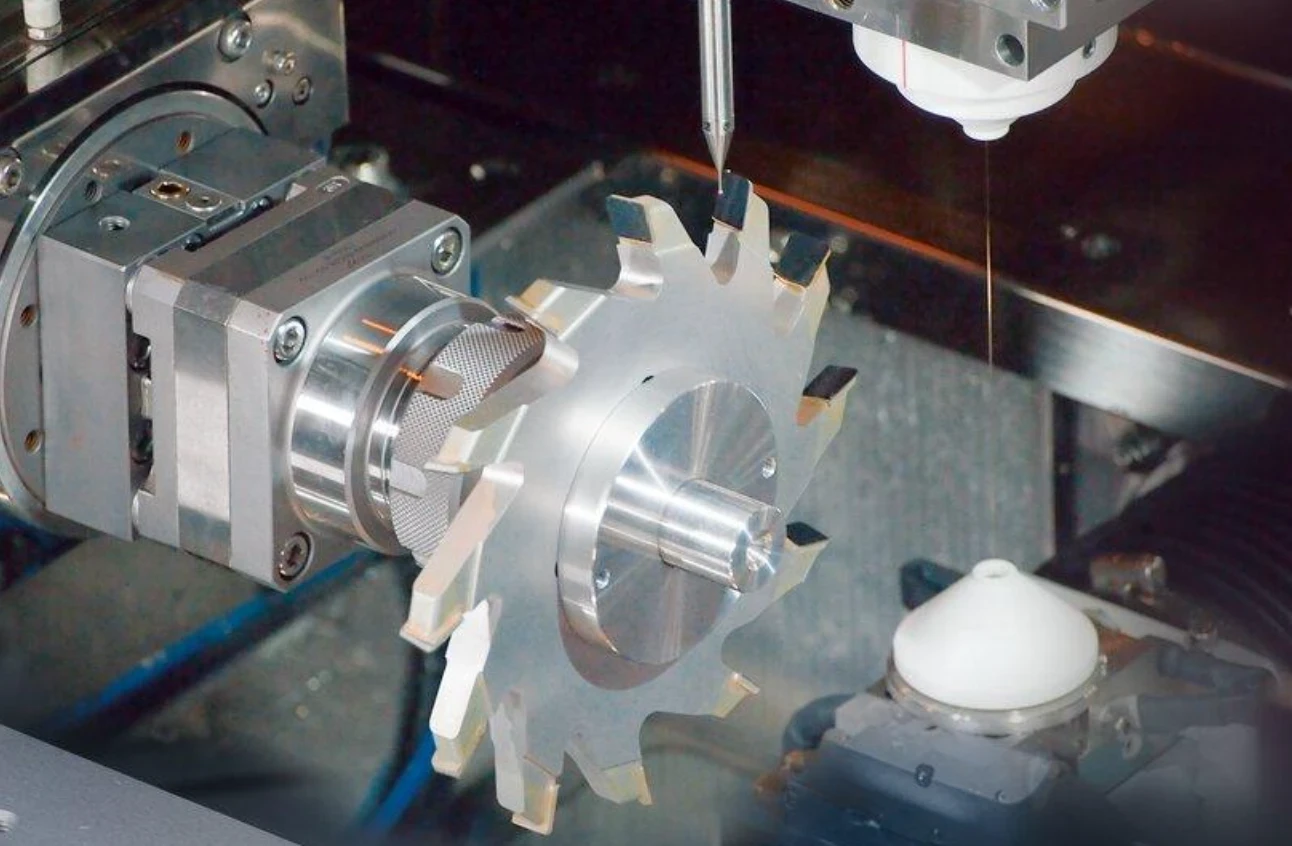
A thin brass or coated wire (0.004 to 0.012 in diameter) runs continuously through the part under tension, with the wire and workpiece both submerged in deionized water. A controlled electrical discharge jumps between the wire and the workpiece thousands of times per second, eroding microscopic amounts of material. There is no mechanical cutting force on the part. Because the process is thermal and electrical rather than mechanical, hardness is irrelevant: D2 at 62 HRC cuts the same as 1018 soft. That is the entire reason wire EDM exists.
The tolerances you can actually hold
A well-run wire EDM holds ±0.0002 in on profile features, ±0.0005 in on true position, and surface finish 32 Ra as-cut, 16 Ra after one skim pass, and 8 Ra after multiple skim passes. Internal corner radius is half the wire diameter plus a small gap, so 0.008 in wire gives a 0.005 in minimum inside radius; 0.004 in wire gives 0.003 in. Taper cuts (up to about 30 degrees for most machines) are routine. The one feature wire EDM cannot do is a true internal corner with zero radius; call out the acceptable radius on the drawing so the shop quotes the right wire.
What drives the price
Three things set the quote on a wire EDM part. Wire length is first: the price scales with part thickness times the cut perimeter, not with part complexity. A 2-inch-thick plate costs twice as much as a 1-inch plate for the same shape. Skim passes are second: each additional pass improves finish and tightens tolerance but adds roughly 20 to 40 percent to the cycle. The last driver is setup, which is a fixed cost per job; this is why small quantities feel expensive and larger lots amortize the setup across more parts.
| Cost factor | Impact | What to do |
|---|---|---|
| Part thickness | Linear with price | Thin where you can; thick only where required |
| Perimeter | Linear with price | Simple perimeters are cheaper than scalloped ones |
| Skim passes | Each pass +20-40% | Call out finish and tolerance; don't over-spec |
| Internal corner radius | Sets wire size | Larger radii = thicker wire = faster cut |
| Quantity | Setup amortizes | A lot of 10 is less than 10x the price of one |
Material and condition callouts
Wire EDM cuts any electrically conductive material: hardened and unhardened tool steels (D2, A2, S7, H13, M2, M4), stainless, Inconel, titanium, copper, brass, aluminum, carbide, and refractory metals. For tool steel, specify the alloy, the hardness in HRC, and whether the part should be heat treated before or after cutting. The usual answer is: heat treat first, then wire EDM to final profile, because wire EDM cuts hardened material exactly the same as soft, and heat treat distortion is avoided. For carbide, specify the grade and the binder; wire EDM cuts tungsten carbide (WC-Co) routinely but needs the right flushing and settings.
The recast layer and when it matters
Every wire EDM cut leaves a thin recast layer (also called white layer) where the material was melted and resolidified by the discharge. For most parts this is cosmetic and does not affect function; the recast layer is roughly 0.0005 to 0.002 in deep on rough cuts and under 0.0002 in after skim passes. For fatigue-critical parts (aerospace, medical implants, mold tooling that will see cycling), spec recast layer removal: either an additional very light skim pass, chemical etch, or a mechanical polish. Call it out on the drawing because the shop will not add the extra pass on their own.
What to put on the wire EDM RFQ
A good wire EDM RFQ includes: material alloy and hardness (D2 at 58-62 HRC, for example), the drawing with critical profile tolerances called out, the finish spec in Ra (or just as-cut if you do not care), any required internal corner radius, whether the part should be cut from hardened stock or hardened post-cut (almost always the former), and the quantity. If the part is a punch, die, or stripper, note which features are datum and which are reference; wire EDM shops see this work daily and will quote correctly if the drawing is clean.
Where to find a shop
Wire EDM is a specialty with far fewer qualified shops than general CNC. OpenSpindle routes wire EDM RFQs to shops that run the process daily, with 4-axis capability for tapered cuts and the inspection discipline (optical comparators, air gages, surface profilometer) that tight tolerances require. See the EDM capability page for process details, or send a drawing and we match it to a shop set up for the job.
Last reviewed by Tom Petrini