Process & DFM
FDM vs SLA vs SLS: Choosing a Process
The short answer
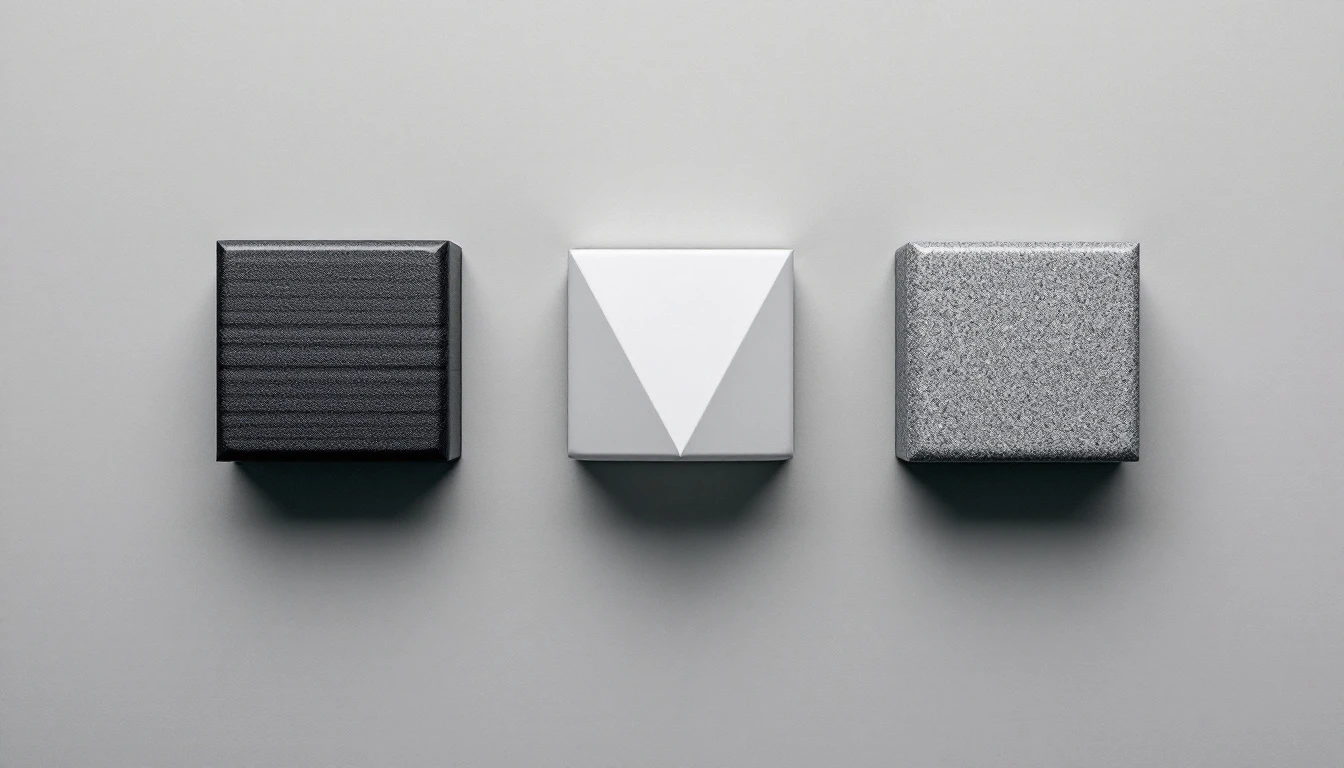
FDM extrudes molten thermoplastic in layers: cheap, widely available and anisotropic, meaning parts are notably weaker across layers. SLA cures liquid resin with light: the most accurate and smoothest of the three, but brittle and degraded by UV over time. SLS fuses powdered nylon with a laser: effectively isotropic, genuinely tough, and needs no support structures, at the cost of a grainy matte surface. Choose by what the part has to survive rather than by resolution.
How each one builds a part
FDM, fused deposition modeling, pushes a thermoplastic filament through a heated nozzle and draws each layer as a path. The part is built from welded together extrusions, and the strength of those welds between layers is the defining property of the process.
SLA, stereolithography, and the related DLP and LCD resin processes, cure a liquid photopolymer with light, one layer at a time. Because a light source can be focused far more finely than a nozzle can be made small, resin processes hold the finest features and the smoothest surfaces.
SLS, selective laser sintering, spreads a thin layer of nylon powder and fuses it with a laser. The unfused powder around the part supports it, which means no support structures, no support scars, and geometry the other two processes cannot build without supports that would be impossible to remove afterwards. The fused nylon is a genuine engineering thermoplastic.
Those three descriptions predict almost every difference in the table below.
Process comparison
Treat tolerance figures as typical rather than guaranteed, since they depend on geometry, size and the specific machine. The tolerance reference chart carries the detail.
| Aspect | FDM | SLA and resin | SLS |
|---|---|---|---|
| Typical tolerance | Around plus or minus 0.3 mm or 0.3 percent | Around plus or minus 0.1 mm or 0.1 percent | Around plus or minus 0.2 mm or 0.2 percent |
| Layer height | 0.1 to 0.3 mm | 0.025 to 0.1 mm | 0.1 mm typical |
| Minimum wall | About 1.0 mm | About 0.4 mm | About 0.7 mm |
| Surface finish | Visible layer lines | Smooth, near injection molded | Uniformly grainy matte |
| Isotropy | Poor, weak across layers | Good | Good |
| Support structures | Required, leave marks | Required, leave marks | None, powder supports the part |
| Common materials | PLA, ABS, PETG, ASA, nylon, polycarbonate | Standard, tough, high temperature, castable, biocompatible resins | PA12, PA11, glass and carbon filled nylons |
| UV stability | Material dependent, ASA good | Poor, most resins degrade and embrittle | Good |
| Cost per part, one off | Lowest | Moderate | Higher |
| Cost at 100 plus parts | Moderate | Moderate | Competitive, nesting improves it |
Anisotropy, the property nobody quotes
An FDM part is not one material. It is a stack of welded extrusions, and the weld between layers is weaker than the extrusion itself. Depending on material and settings, strength across layers can be somewhere around half of the strength along them, and the failure is often brittle rather than ductile.
The practical consequence is that print orientation is a design decision, not a manufacturing detail. A hook, a snap fit, a bracket loaded in bending, a boss that takes a screw: each one has an orientation that works and an orientation that fails on the first load. If a part has a load path that matters, say so, and say which direction the load comes from.
SLA parts are much more isotropic because each layer chemically bonds into the one below rather than being welded to it. SLS is close to isotropic as well, since the powder fuses in all directions.
This single property is the most common cause of a printed part failing in a way that surprises the person who designed it.
Surface finish, and what post processing costs
FDM shows layer lines. On a functional bracket that is irrelevant. On anything cosmetic or customer facing it is the difference between a part that looks manufactured and one that looks printed, and closing that gap means sanding, filling and coating, which is manual labor that quickly exceeds the print cost.
SLA is smooth off the machine, close to an injection molded surface on a good print, which is why it dominates for appearance models, master patterns and anything a customer will hold.
SLS produces a uniformly grainy matte surface. It is consistent and honest looking, hides layer transitions well, and takes dye readily, which is why SLS parts are commonly finished black. Vapour smoothing is available where a sealed, smoother surface is wanted.
Budget for finishing separately from printing. It is frequently the larger number on cosmetic parts, and it is where printed part quotes vary most between suppliers.
Supports, and the geometry each process allows
Supports are a cost and a surface defect. FDM and SLA both need them wherever material would otherwise be printed into air, and where they touch the part they leave marks that need removal.
That has design consequences. Overhangs beyond roughly 45 degrees need support in FDM. Internal channels that cannot be reached to remove supports are a problem in both processes. Resin parts additionally need drain paths, because uncured resin trapped in a closed cavity stays there.
SLS avoids the entire category. The surrounding powder supports the part as it builds, so overhangs, internal lattices, enclosed channels and interlocking assemblies printed in place are all achievable. The one requirement is escape holes so the loose powder can be removed. A part with a fully sealed internal void still builds, but the powder stays trapped inside it, which adds weight and rules the part out wherever that matters.
If a design is full of organic geometry, internal passages or thin unsupported features, SLS is often the only one of the three that will build it cleanly.
When to stop printing
Printing wins on lead time and on the absence of tooling. It stops winning at a quantity that depends on the part, and the crossover is usually earlier than people expect.
Against machining, the crossover is driven by geometry. A simple prismatic part with flat faces and a few holes is often cheaper machined even at quantities of one, and it will be stronger, more accurate and in a real engineering material. Printing wins where the geometry is complex enough that machining needs many setups.
Against injection molding, the crossover is tooling amortization and typically sits somewhere in the hundreds to low thousands of parts. Once you are ordering repeatedly at those volumes, the tool pays for itself and every subsequent part is far cheaper.
The honest signal is repetition. A part you print once is a prototype. A part you have printed four times is a part that should be quoted against machining and molding, because the cost of printing it is recurring and the alternatives are not.
Choosing by what the part has to do
Match the process to the requirement that would cause the part to be rejected.
| Requirement | Process | Why |
|---|---|---|
| Cheap form and fit check | FDM | Lowest cost and fastest turnaround |
| Appearance model or customer facing part | SLA | Smoothest surface, finest detail |
| Functional part that takes real load | SLS | Isotropic and tough in genuine nylon |
| Living hinge or snap fit | SLS | PA11 and PA12 tolerate repeated flexing |
| Fine detail, small features under 1 mm | SLA | Finest achievable feature size |
| Outdoor or UV exposure | SLS, or FDM in ASA | Most resins embrittle under UV |
| Internal channels or lattices | SLS | No supports to remove, needs escape holes |
| High temperature service | FDM in polycarbonate, or high temperature resin | Standard PLA and resins soften early |
| Master pattern for casting | SLA | Surface quality and dimensional accuracy |
| Dozens to hundreds of end use parts | SLS | Nesting the build volume improves cost per part |
What to send, and what to ask
Send an STL or STEP file along with three things the geometry does not convey: what the part has to survive, which direction any load comes from, and whether the surface is cosmetic. Those three decide process, orientation and finishing, and they are the questions a good supplier will ask you anyway.
Say how many you need now and how many you expect over the next year, because the answer changes which process is cheapest and whether printing is the right route at all.
Then ask three questions. What orientation will this be printed in, and does that put the layer lines across my load path? What does the finishing cost, quoted separately from the printing? And at my expected annual volume, what would this part cost machined or molded instead?