Materials
Mild Steel vs Stainless: Which One Your Part Should Be
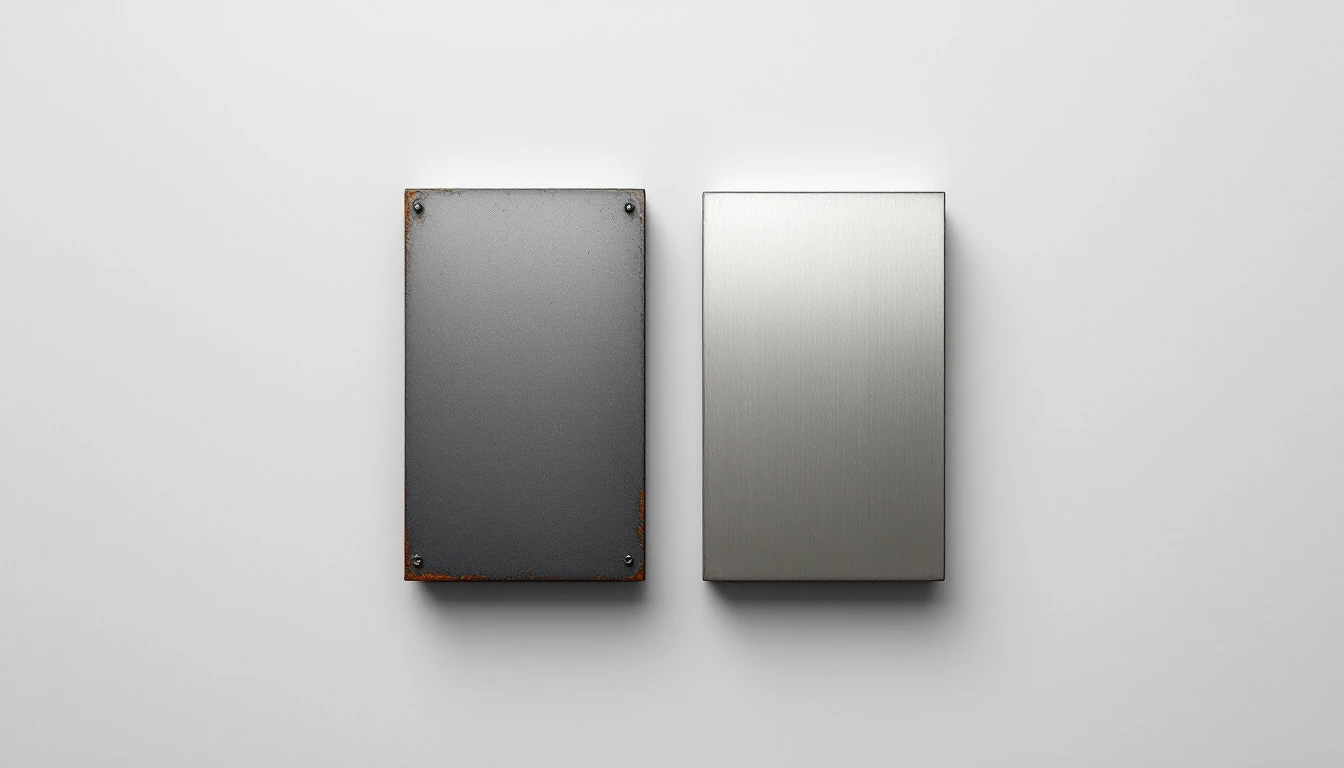
The short answer
Use mild steel when the part will be painted, powder coated or plated anyway, when it needs to be welded easily, and when strength per dollar matters more than corrosion resistance. Use stainless when the part is exposed, needs to stay clean, cannot be coated, or lives somewhere a coating would eventually fail. Mild steel is cheaper per pound and faster to machine; stainless costs more in both and gives that back by needing no finishing and lasting longer in service.
The difference is chromium, and everything follows from it
Mild steel is iron with a small amount of carbon, typically under about 0.3 percent in the grades used for machining and fabrication, such as A36 plate and 1018 bar. It rusts, because there is nothing in it to stop oxidation.
Stainless is steel with at least about 10.5 percent chromium. The chromium forms a thin, self-repairing oxide film on the surface, which is what makes it corrosion resistant. That same chromium, along with the nickel in the common austenitic grades, is what makes it expensive, and it is why it behaves so differently under a cutting tool.
The practical consequences are all downstream of that one difference: stainless costs more, machines slower, work hardens, and does not need a coating. Mild steel is cheap, cuts fast, welds easily, and will rust if you leave it bare.
Property comparison
Representative values for the grades most commonly specified. Treat them as a starting point for comparison rather than design values, since properties vary with form, thickness and condition.
| Property | Mild steel (1018 / A36) | 304 stainless | 316 stainless |
|---|---|---|---|
| Yield strength | About 250 to 370 MPa | About 215 MPa annealed | About 205 MPa annealed |
| Tensile strength | About 400 to 480 MPa | About 505 MPa | About 515 MPa |
| Density | About 7.85 g/cm3 | About 8.0 g/cm3 | About 8.0 g/cm3 |
| Corrosion resistance | None when bare. Rusts quickly. | Good in most environments | Better, including chlorides and salt |
| Relative machinability | High. Cuts fast and predictably. | Moderate. Work hardens, needs rigidity. | Lower than 304 |
| Weldability | Excellent, no special precautions | Good, watch distortion and sensitization | Good, same cautions |
| Magnetic | Yes | Mostly non-magnetic annealed, can become slightly magnetic when cold worked | Same as 304 |
| Needs a coating? | Yes, in nearly every application | No | No |
Yield strength is the trap in this table. Annealed 304 has a lower yield than plain mild steel, which surprises people who assume stainless is simply the stronger material. Stainless earns its place through corrosion resistance, not strength.
What each one does to your quote
Three lines of a quote move, and they do not move in the same direction.
Material. Stainless costs several times more per pound than mild steel. On a part where the blank is a large fraction of the cost, such as a big plate with little material removed, this dominates.
Machine time. Stainless is cut slower, the tools wear faster, and the material work hardens, meaning that a dwelling tool makes the surface harder and the next pass worse. For a part with heavy material removal, the added cycle time can exceed the material cost difference on its own. This is why a complex stainless part is disproportionately more expensive than a simple one.
Finishing. This is the line that moves the other way, and it is the one people forget. A mild steel part is not finished when it leaves the machine: it needs paint, powder, zinc plating or black oxide, or it will rust before it gets installed. That is a separate operation, a separate supplier, a separate lead time, and frequently a lot minimum. A stainless part is often done when it comes off the machine, or needs only passivation.
So the honest comparison is not the price per pound. It is the machined and finished part, delivered. On small simple parts in quantity, mild steel plus powder coat often still wins. On low-quantity parts where the finishing minimum lands on a handful of pieces, stainless can be cheaper in total than the cheap material plus a coating run.
When mild steel is the right answer
The part gets coated regardless. If the design calls for a specific color, or the part is a visible structure that will be powder coated anyway, corrosion resistance is coming from the coating. Paying for stainless underneath a coating is paying twice.
It is a weldment. Mild steel welds without much ceremony, does not need back purging, and distorts less predictably than stainless does. For fabricated frames, brackets and bases, this is a large practical advantage.
The part is thick and simple. Where most of the cost is the blank and the machining is light, the material price difference is the whole story, and mild steel wins by a wide margin.
It needs to be magnetic. Sensor targets, magnetic mounts and anything that has to be held by a magnetic chuck. Annealed austenitic stainless is largely non-magnetic, which is occasionally the deciding factor in the opposite direction.
When stainless earns the premium
It cannot be coated, or the coating would fail. Anything that gets scratched, wiped, abraded or cleaned repeatedly. A coating is a layer that can be breached; stainless corrosion resistance goes all the way through.
Food, medical, marine or outdoor service. Washdown environments end the discussion. 304 covers most of it; specify 316 where chlorides are present, meaning salt water, coastal installations, pool chemistry and many cleaning agents. The added molybdenum in 316 is what buys the chloride resistance.
Appearance is the function. A bead blasted or brushed stainless part looks like a finished product with no coating at all, which removes a whole supplier from the chain.
High or low temperature. Stainless holds up better at elevated temperatures than coated mild steel, where the coating usually fails first.
The maintenance cost is yours. If the part is on a machine you will service for a decade, repainting a rusted bracket repeatedly costs more than the stainless would have.
What to specify, and what to leave to the shop
Specify the grade, not the family. "Stainless" is not orderable. 304 and 316 machine and cost differently, and 303 is a free-machining grade that is far easier to cut but noticeably less corrosion resistant, which is a trade some parts should make and others must not.
Specify the condition for mild steel, and ask for the mill certificate if traceability matters. Hot rolled A36 comes with mill scale and looser dimensions. Cold rolled 1018 is cleaner, more dimensionally accurate and better for machined features. Asking for the wrong one adds a cleanup operation.
Say what the finish has to achieve, not only its name. For mild steel, say whether it is indoor or outdoor, and whether the fastener holes and mating faces must be masked. For stainless, say whether passivation is required, since it usually is for medical and food applications and is often skipped otherwise.
Leave tooling and speeds to the shop. Where you can help is rigidity: stainless punishes thin walls and deep unsupported features far more than mild steel does when machined, so a design that is fine in steel may chatter in stainless.