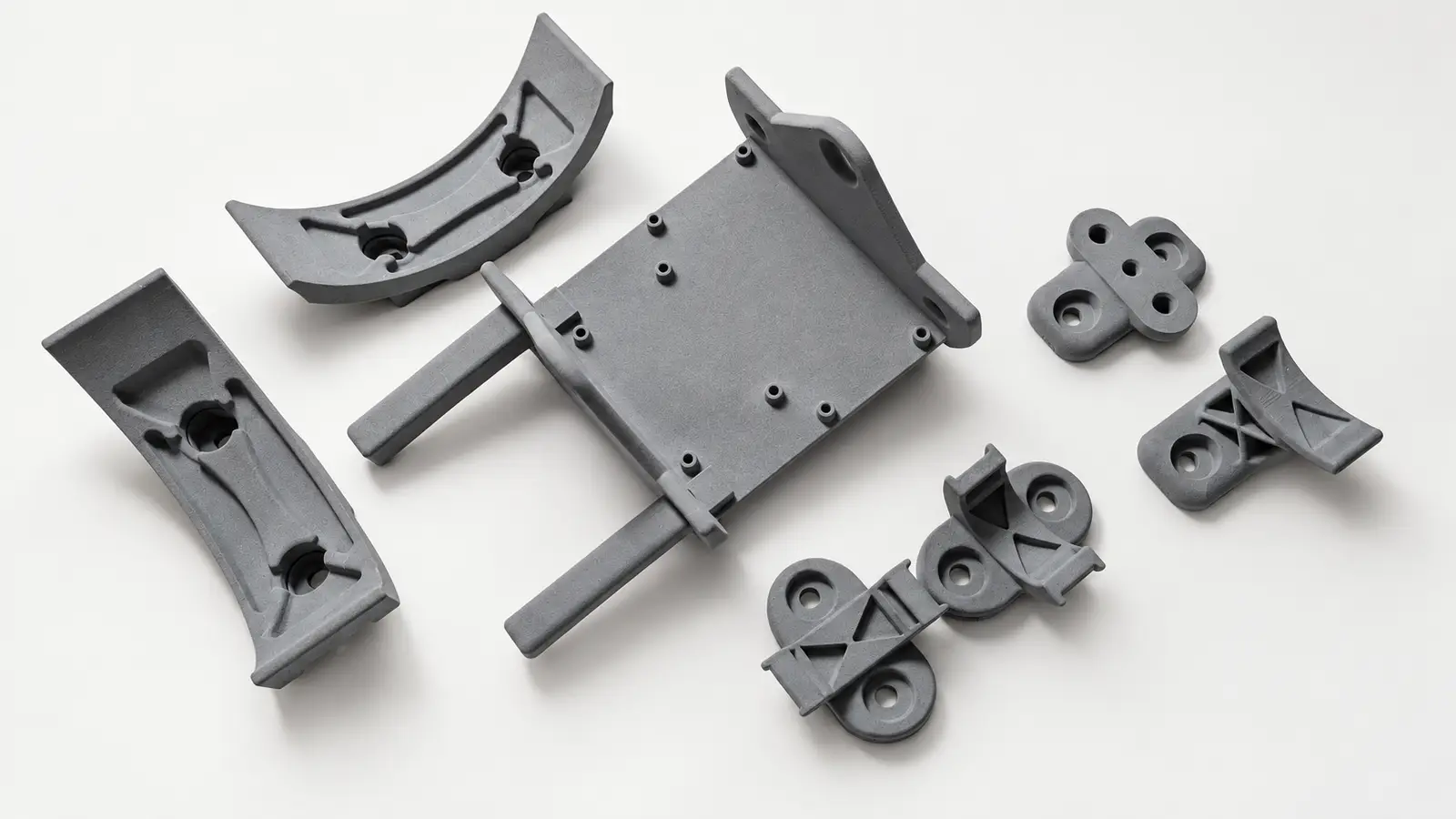
 Made on OpenSpindle
MJF partMade on OpenSpindle
Multi Jet Fusion fuses nylon powder with a printed binding agent and heat, building strong, consistent, near-isotropic parts with no support structures. It resolves finer detail than SLS and runs dense, fast batches, which makes it a workhorse for low-volume production. Common materials are PA12, PA11, glass-filled nylon, and TPU. Upload your model and we'll send you one matched quote from a qualified manufacturing partner.
STEP · STL · IGES · DWG · DXF · SLDPRT · and more
No CAD file? Describe your project instead
Made on OpenSpindleMJF (Multi Jet Fusion) 3D printing is a powder-bed process that jets a binding agent onto nylon powder and fuses it with heat, layer by layer. The surrounding powder supports the part, so it needs no supports and comes out strong and near-isotropic. It suits low-volume production in PA12, PA11, and TPU, with typical tolerance of ±0.3% (min ±0.3 mm).
Last reviewed
Send a part and get a real price. Nothing to commit to, no cost to ask.
One lead from quote to delivery who has sourced it before.
NDA on request. Files shared only with matched shops.
A CAD file or a sketch. Free quote in about 24 hours.
The best-fit shop from our network makes it, on your timeline.

Inspected, shipped and tracked in your inbox.
MJF parts are supported by the surrounding powder bed, so complex geometry comes out clean with no support marks. It holds slightly finer features than SLS.
| Design rule | Typical spec | Why |
|---|---|---|
| Typical tolerance | ±0.3% (min ±0.3 mm) | Consistent part to part across a build. |
| Min wall thickness | 0.5 to 0.8 mm | Thinner walls can warp or fuse incompletely. |
| Min feature size | 0.4 mm | Slightly finer than SLS thanks to the printed agent. |
| Support material | none needed | The powder bed supports the part, so there are no supports to remove. |
| Clearance for moving parts | 0.4 to 0.5 mm | Tighter gaps fuse mating parts together. |
| Escape holes (hollow parts) | ≥ 4 mm, two holes | Let trapped powder drain out of enclosed volumes. |
Typical values from powder datasheets; a shop confirms against its machine and material.
The shop picks the method from your CAD, and the quote tells you which.
MJF nylon is common wherever teams need durable, consistent production parts without tooling.
When another process fits better than Multi Jet Fusion nylon.
| Process | Best for | Typical volume | Choose it over MJF 3D Printing when |
|---|---|---|---|
| SLS | Similar strong nylon parts | Low-volume production | Your shop runs SLS, or you want a specific SLS material; the two are close substitutes. |
| FDM / FFF | Cheap prototypes, large parts | Prototype to low volume | You want the lowest cost or a large part and can accept layer lines. |
| Resin / SLA | Fine detail, smooth cosmetic finish | Prototype | You need the crispest detail or a smooth cosmetic surface over nylon toughness. |
| Injection Molding | High-volume identical plastic parts | 1,000+ | You are past a few hundred parts and can amortize a mold for lower per-part cost. |
Upload a model and we'll source quotes from qualified manufacturing partners.
STEP · STL · IGES · DWG · DXF · SLDPRT · and more
No CAD file? Describe your project instead
MJF (Multi Jet Fusion), an HP powder-bed process, jets a binding agent onto nylon powder and fuses it with heat, layer by layer. The unfused powder supports the part, so it needs no supports and prints strong, near-isotropic parts with consistent mechanical properties.
Both fuse nylon powder with no supports and give strong, near-isotropic parts. MJF uses a printed agent plus heat instead of a laser, which tends to give finer detail, more consistent part-to-part properties, and faster full-bed throughput. SLS offers a slightly wider material range on some machines. For most nylon parts they are close substitutes.
The most common is PA12 (nylon 12), plus PA11 for more ductility and impact resistance, glass-filled nylon (PA12-GF) for stiffness and heat resistance, and TPU for flexible parts. MJF PA12 parts come off the machine grey and are usually dyed black for a uniform finish.
Typical MJF tolerance is about +/- 0.3% of the dimension, with a minimum near +/- 0.3 mm, and it is very consistent from part to part. Call out critical features so the shop can confirm feasibility and orientation.
No. Like SLS, the surrounding powder bed supports the part during the build, so there are no supports to remove and no support marks. That lets MJF print lattices, enclosed features, and interlocking assemblies, and nest parts densely for efficient batches.
Comparing manufacturing services? See Xometry alternatives