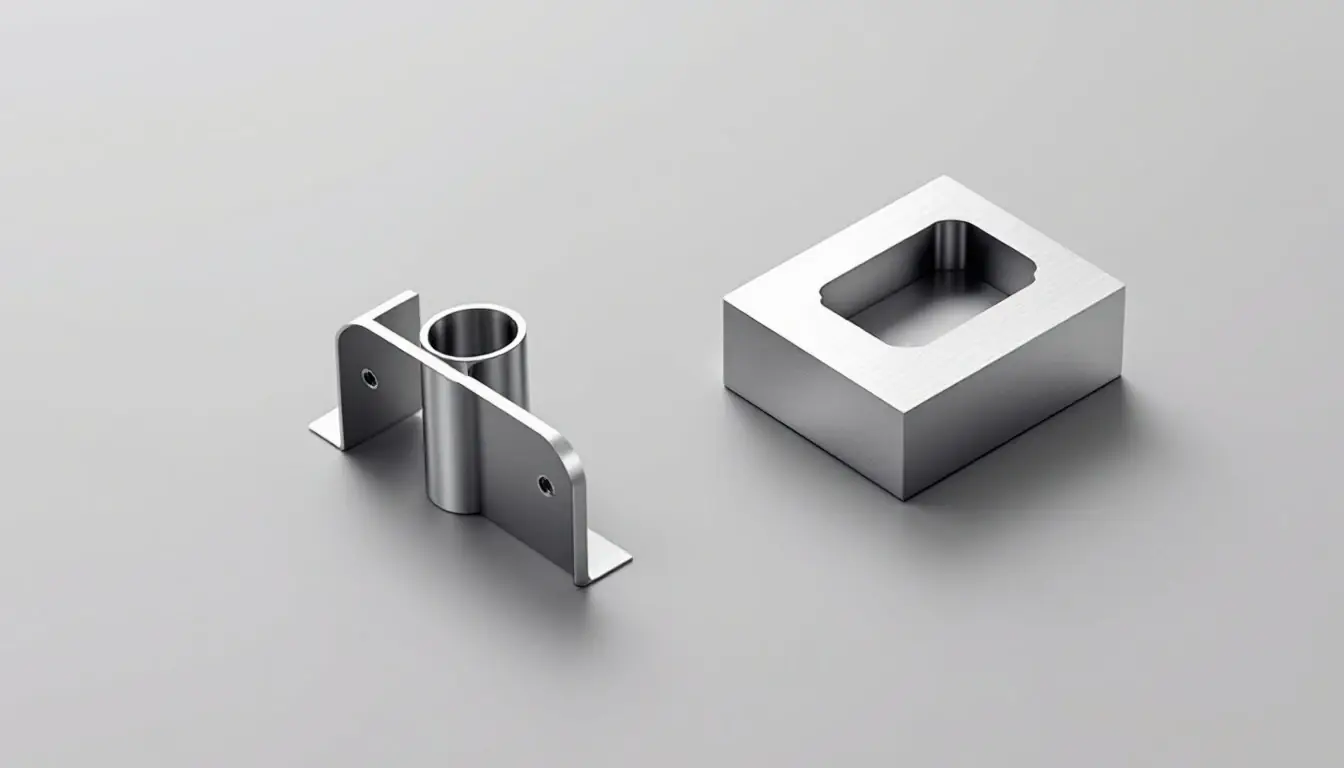
The short answer
Use 5052-H32 for bent sheet metal parts: it forms to tight radii without cracking, welds easily and handles salt water well. Use 6061-T6 for machined parts and for parts that need more strength (about 276 MPa yield against 193 MPa), but give it a larger bend radius, because T6 cracks at the tight bends 5052 takes. Both anodize well; avoid mixing them in an assembly that needs a color match.
Property comparison
| Property (typical) | 5052-H32 | 6061-T6 |
|---|---|---|
| Alloy family | 5xxx, aluminum-magnesium | 6xxx, aluminum-magnesium-silicon |
| How it gets its strength | Strain hardening (not heat treatable) | Solution heat treatment and aging |
| Yield strength | 193 MPa (28 ksi) | 276 MPa (40 ksi) |
| Tensile strength | 228 MPa (33 ksi) | 310 MPa (45 ksi) |
| Elongation (1/16 in sheet) | About 12% | About 12% |
| Fatigue strength (5 × 10⁸ cycles) | About 117 MPa | About 97 MPa |
| Hardness | About 60 HB | About 95 HB |
| Typical min inside bend radius, 90° | About 0.5 to 1x thickness | About 1x in thin sheet, 2 to 3x or more by 1/4 in |
| Weldability | Excellent | Good, with strength loss at the weld |
| Machinability | Fair (gummy) | Good |
| Seawater corrosion | Excellent | Good |
| Density | 2.68 g/cm³ | 2.70 g/cm³ |
| Common forms | Sheet and plate | Sheet, plate, bar, tube, extrusions |
Elongation is close on paper, but a tensile-test number does not predict bending well: the T6 temper tolerates much less local strain at a tight radius than H32. Bend radii are typical starting points; the exact value depends on thickness, tooling and bend direction relative to the rolling grain.
Bending: the reason most sheet parts are 5052
5052-H32 is the default sheet metal aluminum because it bends predictably. In thin gauges it forms to an inside radius of about half to one material thickness, across or along the grain, with little risk of cracking on the outside of the bend.
6061-T6 is a precipitation-hardened temper, and it tolerates far less local stretching at the outside of a bend. Bend it to the radius you would use for 5052 and the outer surface tends to show orange peel, then cracks. Typical guidance is about one thickness in thin sheet, growing to two to three thicknesses or more around 1/4 in, with better results bending across the rolling direction than along it.
If a design needs 6061 strength and tight bends, there are two routes: form the part in a softer temper (O or T4) and heat treat to T6 afterward, which adds cost, lead time and some distortion; or switch to 5052 and thicken the sheet slightly to make up the strength. The second is usually cheaper. Our sheet metal bend radius chart has starting values for other materials.
Machining: where 6061 earns its place
6061-T6 is the most common machined aluminum for good reason. It cuts cleanly, makes short manageable chips, holds a good surface finish and is stocked in almost every bar, plate and extrusion size.
5052 is softer and gummier. It tends to load up cutting edges and leave burrs, so pockets, threads and fine features take more care and more deburring. It machines acceptably with sharp tools and the right coolant, and simple features in a 5052 sheet part (countersinks, tapped holes, a milled pocket) are routine. But a fully machined block part should almost always be 6061, or 7075 if it needs more strength. See 6061 vs 7075 for that comparison.
Welding
5052 welds easily with 5356 filler and needs no heat treatment after. Welding removes the strain hardening near the weld, so the heat-affected zone drops toward annealed (O temper) strength, about 90 MPa yield, but it was not very far above that to begin with.
6061-T6 also welds readily with 4043 or 5356 filler, but it loses much more. The heat-affected zone overages, and welding codes such as AWS D1.2 design 6061-T6 welds to about 165 MPa (24 ksi) tensile against 310 MPa typical for the parent metal. Welded 6061 structures are sized for the weld zone, or re-heat-treated after welding when the part allows it.
For welded sheet enclosures and tanks, 5052 is usually the simpler choice. For welded frames from tube and extrusion, 6061 is common because 5052 is rarely sold in those forms.
Anodizing and appearance
Both alloys anodize well, clear or dyed, and both take Type II and Type III (hardcoat) finishes. The catch is consistency between them. Alloy chemistry changes how the oxide forms, so a 5052 sheet panel and a 6061 machined bracket anodized black in the same tank can come out in visibly different shades.
If an assembly has to match, either build it from one alloy or tell the shop the parts must match so it can plan the tank run and approve a sample. If the best cosmetic finish matters more than strength, 6063 extrusions usually anodize the most uniformly of the three. Specs and thickness classes are on our anodizing spec page.
Where 6063 and 7075 fit
6063 vs 6061. 6063 is the extrusion alloy. It pushes through complex, thin-walled dies more easily, gives a smoother as-extruded surface and anodizes very evenly, which is why architectural trim, frames and many heat sinks are 6063. It is weaker: about 214 MPa yield in T6 and 145 MPa in T5, against 276 MPa for 6061-T6. Choose 6063 for appearance and complex profiles, 6061 for machined or load-bearing parts.
7075. When 6061 is not strong enough, 7075-T6 at about 503 MPa yield is the usual step up for machined parts. It does not suit sheet metal work: it cracks in bending and is not considered weldable by arc processes for structural use.
The aluminum alloy chart compares these and other common alloys and tempers in one table.
Which to choose, by part
| Part | Usual pick | Why |
|---|---|---|
| Bent sheet metal enclosure, chassis or bracket | 5052-H32 | Tight bends, good weldability, good corrosion resistance |
| Marine or outdoor sheet part | 5052-H32 (or 5083 for heavy plate) | 5xxx alloys handle salt exposure best |
| Machined block, housing or fixture | 6061-T6 or T651 plate | Clean machining, wide stock availability |
| Flat laser-cut or waterjet plate with no bends | 6061-T6 or 5052-H32 | Either works; 6061 if it needs strength or later machining |
| Welded tube or extrusion frame | 6061-T6 | Stocked in tube and extrusions; size for weld-zone strength |
| Cosmetic extrusion or trim | 6063-T5 or T6 | Smoothest extruded surface and most even anodize |
| High-strength machined part | 7075-T6 | Nearly twice the yield of 6061-T6 |
What to put on the drawing
Specify the alloy and temper together, not just the alloy: 5052-H32 and 6061-T6 behave very differently from 5052-O and 6061-O. Common callouts are 5052-H32 per ASTM B209 for sheet, 6061-T6 per ASTM B209 for sheet and 6061-T651 for plate, and 6061-T6511 per ASTM B221 for extruded bar.
Give thickness as a decimal, not a gauge. Put the inside bend radius on the drawing for formed parts, and if 6061 must be bent, note the bend direction relative to grain or let the shop recommend a radius. If anodized parts in an assembly must match, say so in the finish note.
Sources
- Aluminum Association, Aluminum Standards and Data
- Aluminum Association, International Alloy Designations and Chemical Composition Limits (Teal Sheets)
- ASTM B209, Aluminum and Aluminum-Alloy Sheet and Plate
- ASTM B221, Aluminum and Aluminum-Alloy Extruded Bars, Rods, Wire, Profiles, and Tubes
- AWS D1.2, Structural Welding Code: Aluminum
- ASM Handbook, Volume 2 (ASM International)
- MatWeb material property data
Last reviewed by Tom Petrini