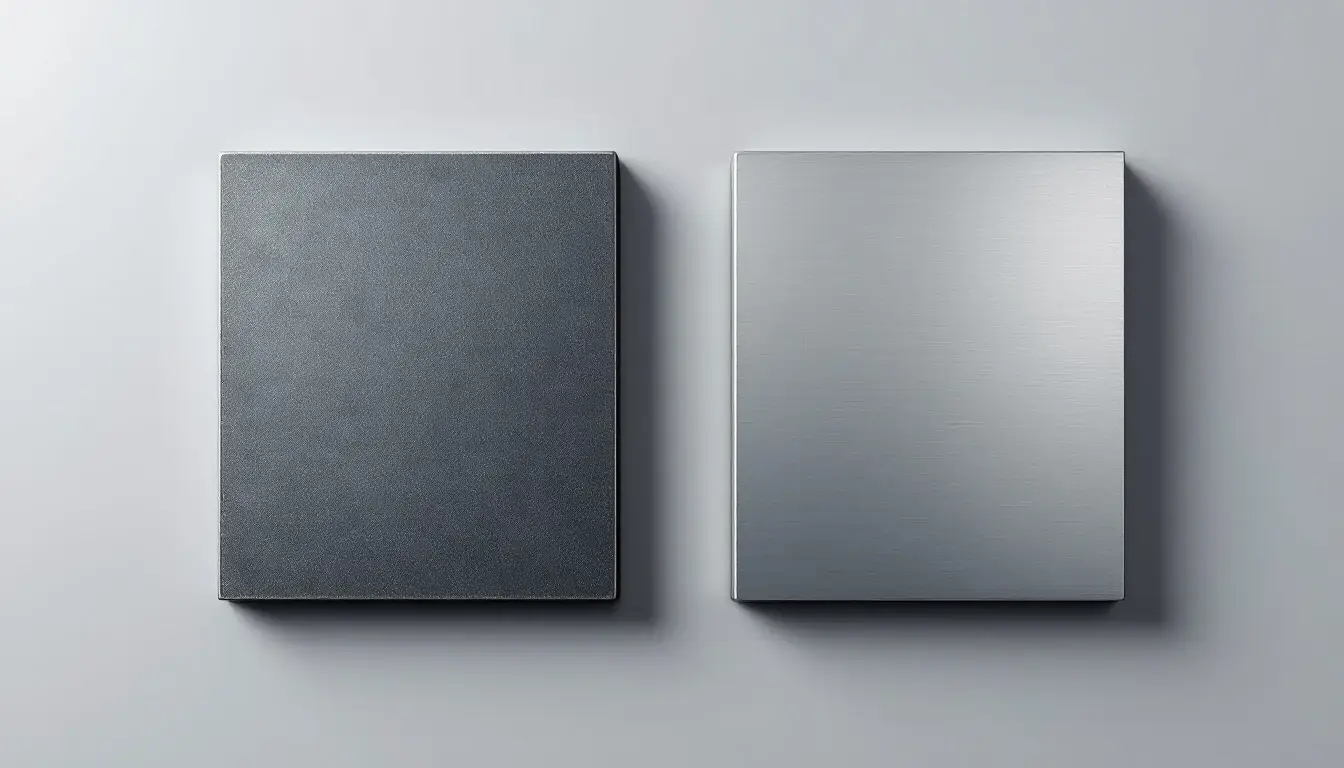
The short answer
Hot rolled steel, such as A36, is finished at high temperature, so it carries mill scale, looser thickness tolerance and less flatness, but it costs the least. Cold rolled or cold drawn steel, such as 1018, is reduced further at room temperature for a smooth surface, tighter tolerance and, in bar, higher strength. HRPO is hot rolled with the scale pickled off. Use hot rolled for structure and plate, HRPO for clean laser-cut and coated parts, and cold rolled for thin precise sheet and machined bar.
What mild steel is, and where A36 and 1018 fit
Mild steel is the everyday name for low-carbon steel: plain iron-carbon steel with roughly 0.05 to 0.25 percent carbon and small amounts of manganese. Low carbon makes it ductile, easy to weld and easy to form, but it cannot be through-hardened much by heat treatment. It is the default metal for brackets, frames, enclosures, plates and weldments when the part will be painted, powder coated or plated.
Two names cover most of what buyers order:
- A36 is an ASTM structural specification, not a chemistry. It guarantees a 36 ksi (250 MPa) minimum yield and a 58 to 80 ksi tensile range, with loose chemistry limits. It is sold hot rolled, in plate, structural shapes and bar.
- 1018 is an SAE/AISI chemistry (about 0.15 to 0.20 percent carbon, 0.60 to 0.90 percent manganese). It is most often bought as cold drawn bar for machining.
For thinner sheet, the common hot rolled spec is usually ASTM A1011 and cold rolled sheet is usually ASTM A1008, both in commercial steel (CS) or structural steel (SS) grades. Hot rolled and cold rolled describe how the steel was finished at the mill, which is a separate question from the grade.
How hot rolled, HRPO and cold rolled are made
Hot rolled (HR). The steel is rolled to size while it is well above its recrystallization temperature, typically finished above about 1,500 °F (815 °C), then cooled in air. As it cools it forms a blue-gray iron oxide skin called mill scale, and it shrinks slightly and unevenly, so final size and flatness are less controlled.
Hot rolled, pickled and oiled (HRPO or P&O). Hot rolled sheet or coil run through an acid bath to strip the mill scale, then coated with a light oil so it does not rust in storage. Tolerances and strength are the same as hot rolled; the surface is clean dull gray.
Cold rolled (CR) and cold drawn (CD). Pickled hot rolled steel is reduced further at room temperature, by rolling for sheet and strip or drawing through a die for bar. Sheet is usually annealed and given a light temper pass afterward, so its strength ends up close to hot rolled but its surface, tolerance and flatness are much better. Cold drawn bar is usually not annealed, so it keeps the work hardening and comes out noticeably stronger than hot rolled bar of the same grade.
Side-by-side comparison
| Property | Hot rolled (A36, A1011) | HRPO | Cold rolled sheet (A1008) / cold drawn bar (1018 CD) |
|---|---|---|---|
| Surface | Blue-gray mill scale, rough | Clean dull gray, oiled | Smooth, bright, oiled |
| Thickness or size tolerance | Loosest | Same as hot rolled | Noticeably tighter |
| Flatness and squareness | Least flat; bar has rounded corners | Same as hot rolled | Flatter sheet; sharp, square bar edges |
| Yield strength (typical) | A36: 250 MPa (36 ksi) min | Same as hot rolled grade | CR sheet: similar to HR. 1018 CD bar: about 370 MPa (54 ksi) |
| Residual stress | Lower, but cooling stresses exist | Same as hot rolled | Higher near the surface of cold drawn bar |
| Rust behavior in storage | Scale slows rust until it cracks | Rusts once oil is removed | Rusts once oil is removed |
| Relative cost | Lowest | Small premium over HR | Highest of the three |
Exact tolerances are set by ASTM A6 (plate and shapes), A568 (sheet) and A108/A29 (bar) and depend on thickness and width. Ask the shop if a dimension depends on raw stock size.
Residual stress: why cold drawn bar moves when you machine it
Cold drawing compresses the outside of a bar and leaves balanced locked-in stresses between surface and core. Machine material off one side, cut a long slot, or turn a thin-walled sleeve, and the balance changes: the part bows or twists as the remaining stresses redistribute.
That is why a 1018 CD flat bar that was straight on the rack can come off the mill with a bow you can see. Shops manage it by roughing, letting the part relax, then finishing, or by machining both sides evenly. For long, asymmetric or tight-flatness parts, the better buy is often hot rolled bar with extra stock to clean up, stress-relieved cold drawn bar, or precision ground flat stock.
Hot rolled plate is not stress free either. Cooling and leveling leave stress that can make plate spring when it is burned or deeply pocketed, though it is usually milder than in cold drawn bar. If flatness is critical on a laser-cut or plasma-cut plate part, say so; the shop may recommend a leveled or stress-relieved plate.
Which to pick, by process
| Process | Usual pick | Why |
|---|---|---|
| Laser cutting thin sheet (up to about 3 mm) | Cold rolled (A1008) or HRPO | Clean surface gives consistent pierce and edge quality and less dross |
| Laser, plasma or waterjet cutting plate | HRPO where available, A36 hot rolled for thick plate | Mill scale can cause inconsistent pierces and spatter; HR is the economical choice for heavy plate |
| Bending in a press brake | Cold rolled for tight radii, HR or HRPO for brackets and structure | CR forms around 0.5 to 1x thickness; scale can flake at HR bends |
| Welding | Any; clean the joint | Low carbon welds easily, but scale and oil in the joint cause porosity, especially with TIG |
| Machining | 1018 CD for small precise parts; HR bar for heavy stock removal | CD holds size and finish; HR has less residual stress but needs a cleanup allowance |
| Paint or powder coat | HRPO or cold rolled | Mill scale under a coating can let go later and take the coating with it |
These are common defaults, not rules. Partner shops sometimes substitute based on what they stock; if the condition matters to the part, put it on the drawing.
Mill scale and finishing
Mill scale is hard and brittle, and it bonds to the steel poorly enough that it eventually cracks and flakes, particularly where a part is bent or flexes. If you paint or powder coat over it, the coating is only as attached as the scale is.
For coated parts, either buy HRPO or cold rolled, or have the shop remove scale by blasting or pickling before coating. Both add cost on hot rolled stock, so it is usually cheaper to start with HRPO. For hot-dip galvanizing, the galvanizer pickles the steel as part of the process, so hot rolled is usually fine.
One laser-specific note: steel cut with oxygen assist leaves a thin oxide layer on the cut edge, regardless of the starting surface. If edge adhesion matters for the coating, ask for nitrogen-cut edges or edge prep, and see our mild steel vs stainless comparison for when an uncoated stainless part is the simpler answer.
What to put on the drawing or RFQ
"Mild steel" or "CRS" alone leaves the choice to the shop. That is fine for a bracket that gets powder coated; it is not fine if strength, flatness or appearance matters. A clear callout names the spec, the condition, and the thickness in decimal units rather than gauge.
- Structural plate: ASTM A36, hot rolled, 0.375 in.
- Laser-cut and powder-coated sheet: ASTM A1011 CS Type B, HRPO, 0.120 in.
- Thin precise sheet or tight bends: ASTM A1008 CS Type B, cold rolled, 0.060 in.
- Machined bar: 1018 cold drawn per ASTM A108, or hot rolled 1018 if flatness after heavy machining matters more than stock size.
Add a mill test report request if the part is structural or traceable. More on the alloys themselves is on our carbon steel material page.
Sources
- ASTM A36, Carbon Structural Steel
- ASTM A1011, Steel, Sheet and Strip, Hot-Rolled, Carbon, Structural, HSLA
- ASTM A1008, Steel, Sheet, Cold-Rolled, Carbon, Structural, HSLA
- ASTM A568, General Requirements for Steel Sheet, Carbon, Structural, and HSLA
- ASTM A6, General Requirements for Rolled Structural Steel Bars, Plates, Shapes, and Sheet Piling
- ASTM A108, Steel Bar, Carbon and Alloy, Cold-Finished
- MatWeb material property data
Last reviewed by Tom Petrini