Custom acrylic sheet parts: laser cut, routed, and machined
Acrylic is the clearest, most scratch-resistant of the common clear plastics, and it is the material CO2 lasers cut best. Whether your part is laser cut, routed, or machined depends on whether you specify cast or extruded sheet, how thick it is, and what the edge has to look like. Upload your drawing and we'll send you one matched quote from a partner shop that cuts it.
STEP · STL · IGES · DWG · DXF · SLDPRT · and more
No CAD file? Describe your project instead
What is acrylic?
Acrylic (PMMA, polymethyl methacrylate) is a rigid, transparent thermoplastic that transmits about 92% of visible light, more than ordinary window glass or polycarbonate. It resists UV and scratches better than polycarbonate but is brittle under impact. Sold as cast or extruded sheet under names like Plexiglas, Acrylite, and Lucite, it is laser cut, routed, and machined into signs, displays, light guides, and covers.
Last reviewed
Why work with OpenSpindle
No-obligation quote
Send a part and get a real price. Nothing to commit to, no cost to ask.
A person to talk to
One lead from quote to delivery who has sourced it before.
Your files stay private
NDA on request. Files shared only with matched shops.
Laser, router, or CNC: how acrylic gets cut
Most acrylic quotes turn on three questions: how thick, cast or extruded, and does the edge show.
Laser
Best for flat parts up to about 1/2 in
A CO2 laser vaporizes acrylic and leaves a clear, glossy edge in one pass, with tolerances typically around +/- 0.005 to 0.010 in. Thick cuts show some taper and cost more time. Fiber lasers generally do not cut clear acrylic, because most of their wavelength passes through it.
Router
Thick sheet, big panels, square edges
Routing cuts any thickness the machine can clear and leaves a square edge with no taper. The edge is matte with tool marks, so visible edges are flame, buff, or diamond polished afterward, which adds labor.
CNC
3D features and optical parts
Milling handles pockets, counterbores, threads, lens profiles, and light pipes. Cast acrylic machines cleanly; extruded tends to gum and chip. Polished optical faces are a separate operation and should be called out.
Stress
Crazing after cutting
Laser cutting and aggressive machining leave stress at the edge. Cleaning with alcohol or solvent bonding a stressed edge can craze it into fine cracks. Annealing after cutting, or specifying cast sheet, prevents most of it.
Cast or extruded acrylic, and which grade?
The first choice on any acrylic drawing is cast or extruded. They look the same on the shelf and behave differently on the machine. If your grade is not here, ask when you request a quote.
Cast acrylic
Made by polymerizing between glass plates or in cells. Higher molecular weight, lower internal stress, and better resistance to solvents and crazing. It routes and machines cleanly, laser cuts to a glossy edge, and engraves frosty white. Thickness varies more across a sheet, often by 10% or more of nominal.
Best for Machined parts, engraved signs, thick blocks, solvent-bonded assemblies
Extruded acrylic
Pushed through a die. Cheaper, with tighter thickness tolerance and lower molecular weight, so it laser cuts fast to a very clear, flame-polished edge. It carries more internal stress, so laser-cut or solvent-exposed edges can craze or crack unless the part is annealed. Engraves clear rather than white.
Best for Laser-cut signs, displays, covers, high-volume flat parts
Colored, tinted, and fluorescent
Transparent tints, opaque colors, and edge-glow fluorescents in both cast and extruded. Color is in the material, so it runs through the cut edge.
Best for Signage, retail displays, decorative panels
Impact-modified acrylic
Rubber-modified acrylic with several times the impact strength of standard sheet, at some loss of clarity and stiffness. Still well below polycarbonate.
Best for Point-of-purchase displays, light-duty guards, shipping-sensitive parts
Light guide (LGP) and diffuser grades
Optical grades made to carry light from an edge and spread it evenly, or to diffuse a backlight. Usually extruded, with a dot or etched pattern added by laser, print, or machining.
Best for Edge-lit signs, backlit panels, light guide plates
How acrylic parts are made
The right process depends on part geometry, tolerances, and production volume.
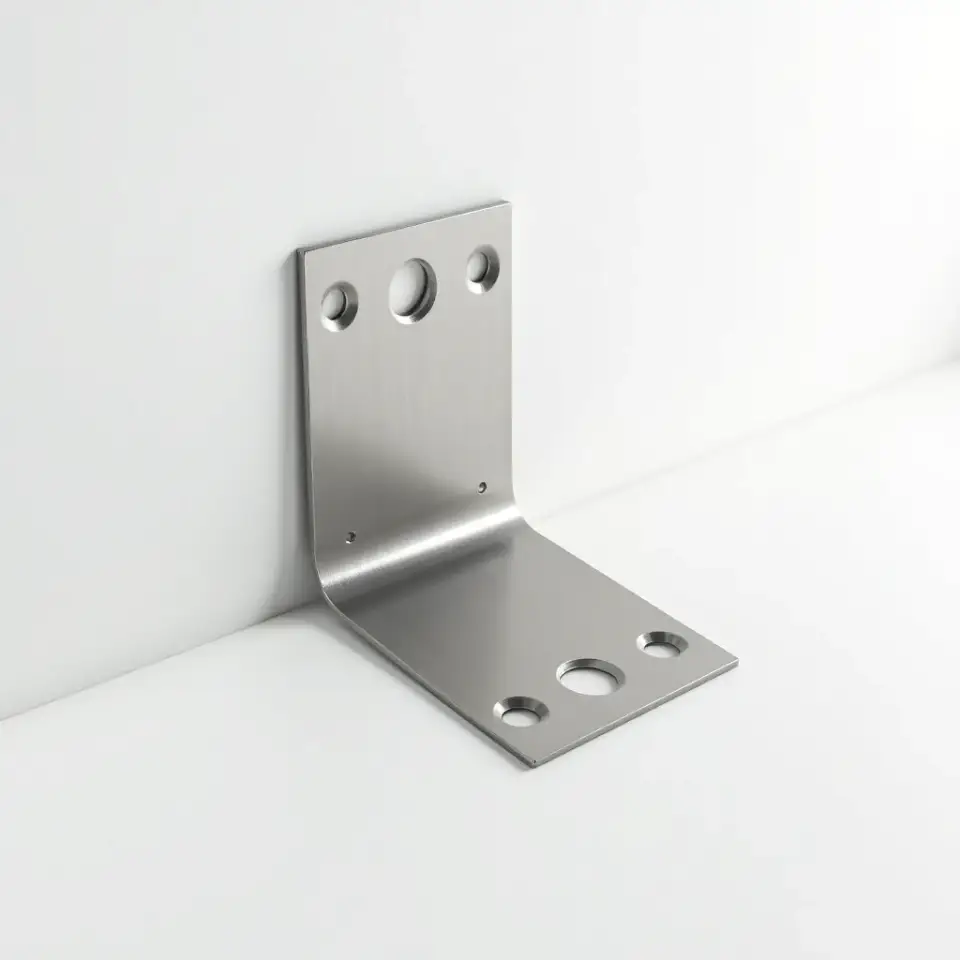 CO2 Laser CuttingThe usual process for flat acrylic up to about 1/2 in. Leaves a glossy, flame-polished edge with no secondary finishing.
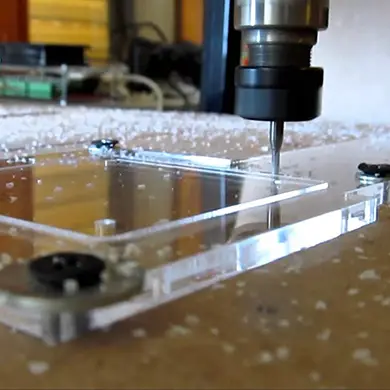 CNC RoutingThicker sheet, large panels, countersinks, pockets, and square, untapered edges. Edges come off matte and are polished if they show.
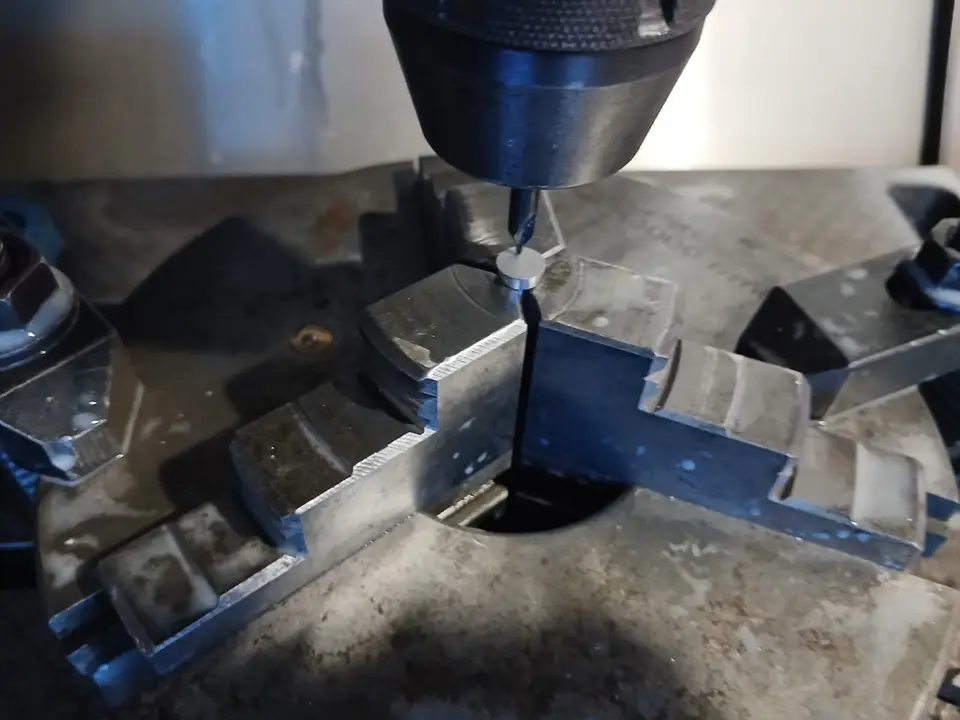 CNC MachiningLenses, light pipes, manifolds, and blocks milled from cast acrylic plate.
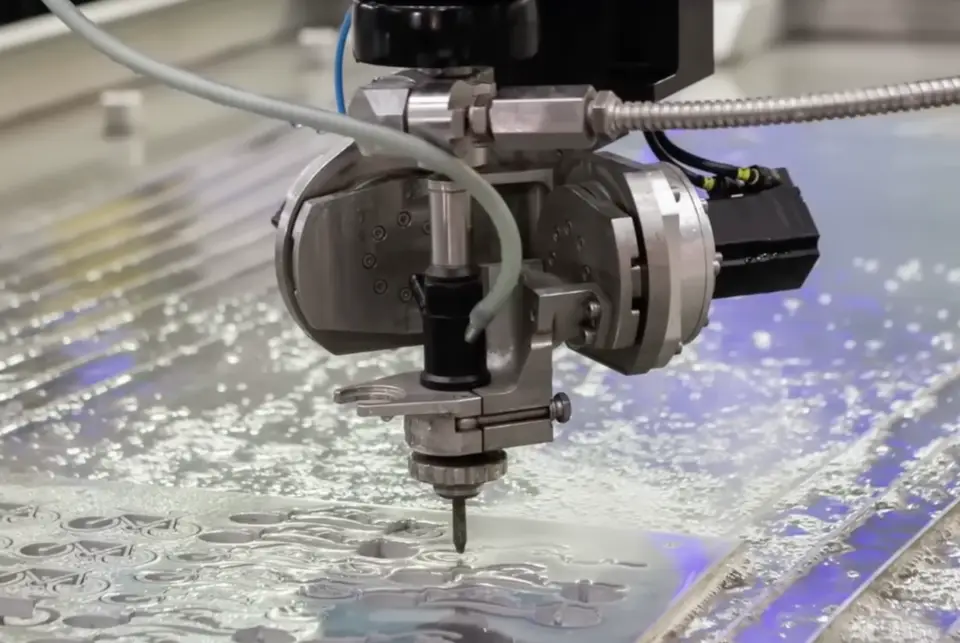 Waterjet CuttingPossible for thick acrylic, but piercing can chip it and the edge is frosted, so routing is usually preferred.
What are the key properties of acrylic?
Typical values for clear, unmodified acrylic sheet. Cast and extruded differ slightly, so check the data sheet for a critical part.
| Property | Typical value |
|---|---|
| Density | ~1.19 g/cm³ (0.043 lb/in³) |
| Tensile strength | ~9 to 11 ksi (62 to 76 MPa) |
| Light transmission | ~92% (clear, 1/8 in) |
| Max continuous service temp | ~70 to 90 °C (160 to 195 °F), cast at the upper end |
| Impact resistance (notched Izod) | Low, ~0.3 to 0.5 ft-lb/in; brittle |
| Hardness | Rockwell M ~90 to 100, harder than polycarbonate |
| Moisture absorption | ~0.2 to 0.4% (24 h) |
| Thermal expansion | ~70 µm/m·°C, roughly 6 times steel |
Acrylic is stiff and scratch resistant but notch sensitive. Sharp inside corners, tight hole-to-edge distances, and over-torqued fasteners start cracks. Give holes clearance, keep holes at least about two material thicknesses from an edge where you can, and radius inside corners.
Acrylic parts in 3 steps
Upload your part
A CAD file or a sketch. Free quote in about 24 hours.
We match + manufacture
The best-fit shop from our network makes it, on your timeline.
Receive + review
Inspected, shipped and tracked in your inbox.
What stock forms does acrylic come in?
Sheet & plate
Clear, colored, frosted, and mirrored sheet from about 1/16 in to 1 in and up, in cast and extruded. Rod, tube, and cast blocks are also common.
What finishes work on acrylic?
Acrylic is not plated or anodized. Finishing is about the edge, the face, and how parts are joined.
Laser-cut edge
Glossy and clear straight off the machine. The cheapest polished edge, limited to what the laser can cut.
Flame polished
A torch reflows a routed or machined edge to clear. Fast, but it adds stress, so avoid it on parts that will be solvent bonded.
Buffed or diamond polished
Mechanical polishing gives the flattest, clearest edge and the least stress. The choice for display cases and optical edges.
Frosted or sanded
Sanded or bead-blasted faces diffuse light and hide fingerprints.
Solvent bonding
Acrylic welds to itself with a thin solvent cement, giving clear, nearly invisible joints for boxes and display cases. Joints need flat, square, unpolished mating edges.
Masking left on
Sheet ships with paper or film masking. Leaving it on through cutting keeps faces scratch free. Say if you want it left on for shipping.
Call out which edges are cosmetic. Polishing every edge on a part where only the front shows is a common source of avoidable cost.
Where are acrylic parts used?
Acrylic shows up wherever a part has to look clear, take light well, or carry a sign, and does not have to take a hard impact.
- Signs & lettering
- Retail & POP displays
- Display cases & boxes
- Light guides & edge-lit panels
- Lenses & light pipes
- Machine & instrument covers
- Sneeze guards & partitions
- Aquarium & tank windows
- All industries
How does acrylic compare to other materials?
How acrylic compares with the other clear and sheet plastics shops quote.
Acrylic vs Polycarbonate
Polycarbonate- Acrylic is clearer, harder, more scratch resistant, and does not yellow in sunlight
- Polycarbonate is many times tougher; it bends where acrylic cracks
- Acrylic laser cuts to a polished edge; polycarbonate discolors under a CO2 laser and is usually routed or machined
- Acrylic usually costs less
Choose acrylic for signs, displays, light guides, and covers that will not be hit. Choose polycarbonate for guards, shields, and anything that has to survive impact.
Acrylic vs HDPE
HDPE- HDPE is opaque or translucent, tough, and chemically resistant
- Acrylic is rigid and clear and holds tolerance better
- HDPE does not laser cut cleanly; acrylic does
Choose acrylic when clarity or appearance matters. Choose HDPE for cutting boards, tank parts, and outdoor panels.
Get an acrylic part quote
Upload your DXF or drawing and we'll send you one matched quote from a partner shop that laser cuts, routes, and machines acrylic.
- Free quote in about 24 hours
- No minimum order
- No account needed to start
STEP · STL · IGES · DWG · DXF · SLDPRT · and more
No CAD file? Describe your project instead
Frequently asked questions
What is the difference between cast and extruded acrylic?
Cast acrylic has higher molecular weight and less internal stress, so it machines cleaner, resists crazing and solvents better, and engraves white. Extruded acrylic is cheaper, has tighter thickness tolerance, and laser cuts fast to a clear edge, but stressed edges can craze when cleaned with alcohol or solvent bonded. Specify which one on the drawing.
How thick can acrylic be laser cut?
Many shops laser cut acrylic up to about 1/2 in (12 mm), and some higher-power machines go thicker. Above that, or when the edge has to be square with no taper, routing is usually the better and cheaper choice.
Does laser cutting acrylic leave a polished edge?
Yes, in most cases. A CO2 laser leaves a glossy, flame-polished edge on both cast and extruded acrylic. Thick cuts can show slight taper or striations, and routed edges need a separate polishing step to match.
What tolerances can acrylic hold?
Laser-cut acrylic typically holds around +/- 0.005 to 0.010 in, and CNC machined cast acrylic can hold tighter on small features. Sheet thickness itself varies, especially in cast, so do not tolerance thickness tighter than the sheet is made to unless the part is machined to thickness.
Is acrylic the same as Plexiglas or Lucite?
Yes. Plexiglas, Acrylite, Lucite, and Perspex are brand names for acrylic (PMMA) sheet. Lexan and Makrolon are brand names for polycarbonate, which is a different material.
Can acrylic be bent?
Yes, with heat. Acrylic is line bent on a strip heater or thermoformed in an oven. Bending standard sheet cold usually cracks it. Very tight bends in thick sheet can whiten or stress the outside of the bend, so give the shop a bend radius rather than a sharp corner.
What file formats should I send for acrylic parts?
A DXF is enough for laser cut or routed flat parts. Send STEP or a dimensioned PDF for machined parts. Include cast or extruded, thickness, color, which edges are cosmetic, and quantity.
Charts for acrylic drawings
Other materials
Sources
- MatWeb, overview of materials for acrylic (PMMA), cast and extruded
- ASTM D4802, Standard Specification for Poly(Methyl Methacrylate) Acrylic Plastic Sheet
- Plexiglas and Acrylite acrylic sheet manufacturer physical property and fabrication data
Last reviewed by Tom Petrini